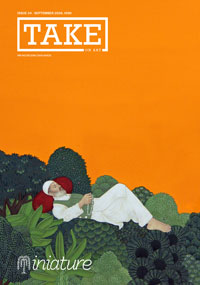


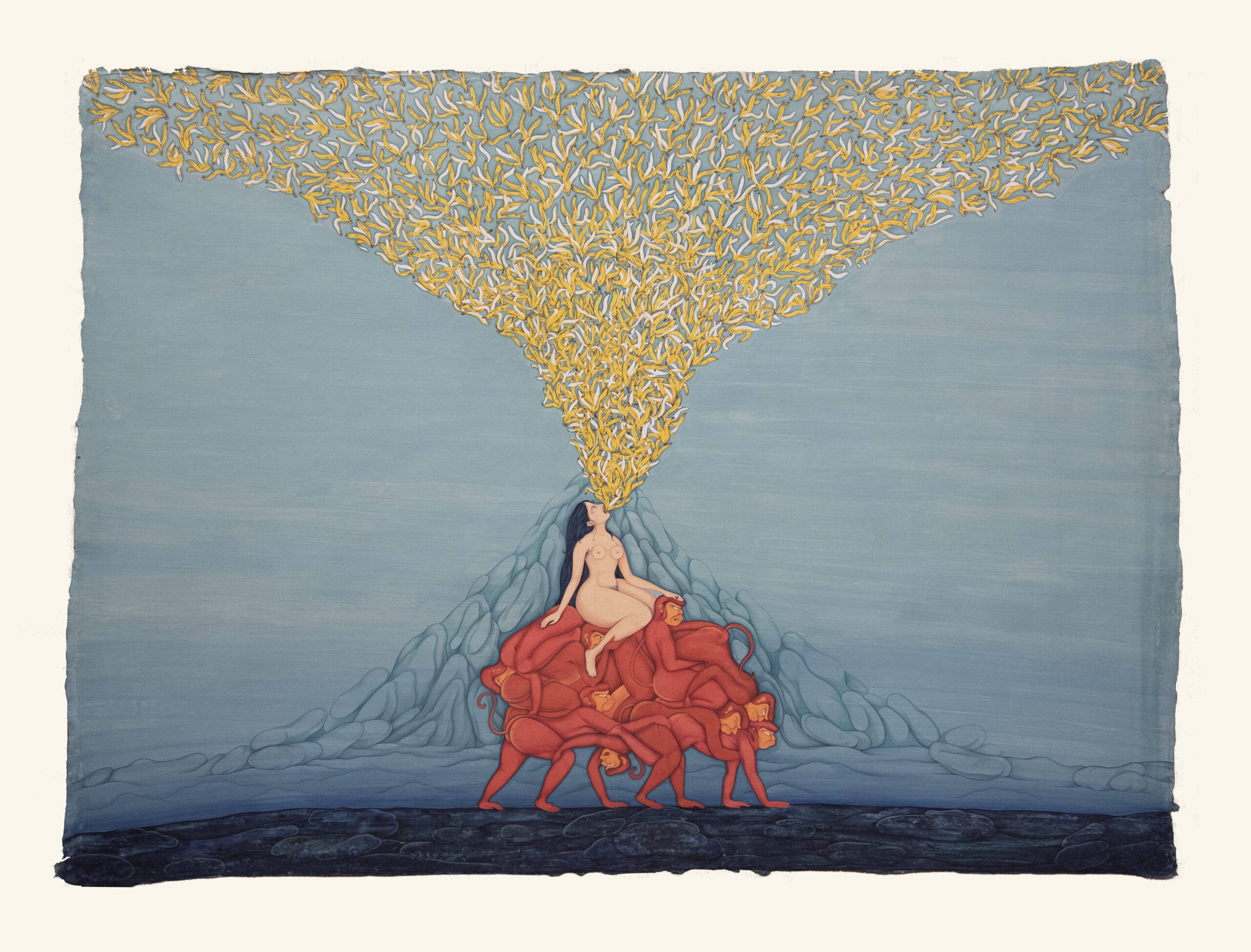
Gargi Chandola, Puge, Gouache on Wasli.
She is her Self.
She is memory, and body.
She is also the landscape and forest.
She is soft and strong, loud and quiet, beautiful and grotesque…
She evolves with the consciousness of a thousand women before her, and will pass it on to ten thousand after. She is a mountain of love, concealing and revealing mythologies.
To describe the work “God Empress of Dune” by Gargi Chandola without employing poetic responses would be doing it an injustice. It is a timeless contemporary visualisation that embodies the spirit of countless beings and generations; representing experiences, memories, power and vulnerability, and the identities of women across time and space. For me, it also embodies the lens through which this essay explores the work of three women – Vinita Sharma, Mainaz Bano, and Gargi Chandola – who are working within the visual legacy of miniature painting, sharing a common contemporary. Each of them highlights an innate capacity to poetically bring forth what is personal and private, even while engaging with and shaping collective thought and expression. Through their work, we encounter what they witness, how they understand, define and express, where their lives’ experience is leading them. We are introduced to their visions of their past and present, their dreams for the future. Significantly, we understand how they derive from, and yet break-away and redefine the rules of miniature painting.
The Storyteller
Vinita Sharma has been painting for around three decades. With a natural affinity to art and aesthetics, she was guided by her husband, prominent miniature painter Ajay Kumar Sharma, in the intricacies of miniature painting. While their repertoire includes Pahari, Kangra and other Indian styles, the larger focus is on the Mughal tradition. After her training, as their children grew older, Vinita had more time to spend on painting, and moved between creating experimental compositions, and more traditional ones that were commissioned and in demand.
An early self-portrait titled “Wandering Thoughts” demonstrates her fluid use of the medium, and her comfort with the rules of miniature painting, that she dissolves in order to express something deeply personal. The composition, in soft blues and browns, depicts the protagonist seemingly in a day-dream while her imagination is fed by the many manuscripts and books that are perhaps her learning blocks as an evolving artist.
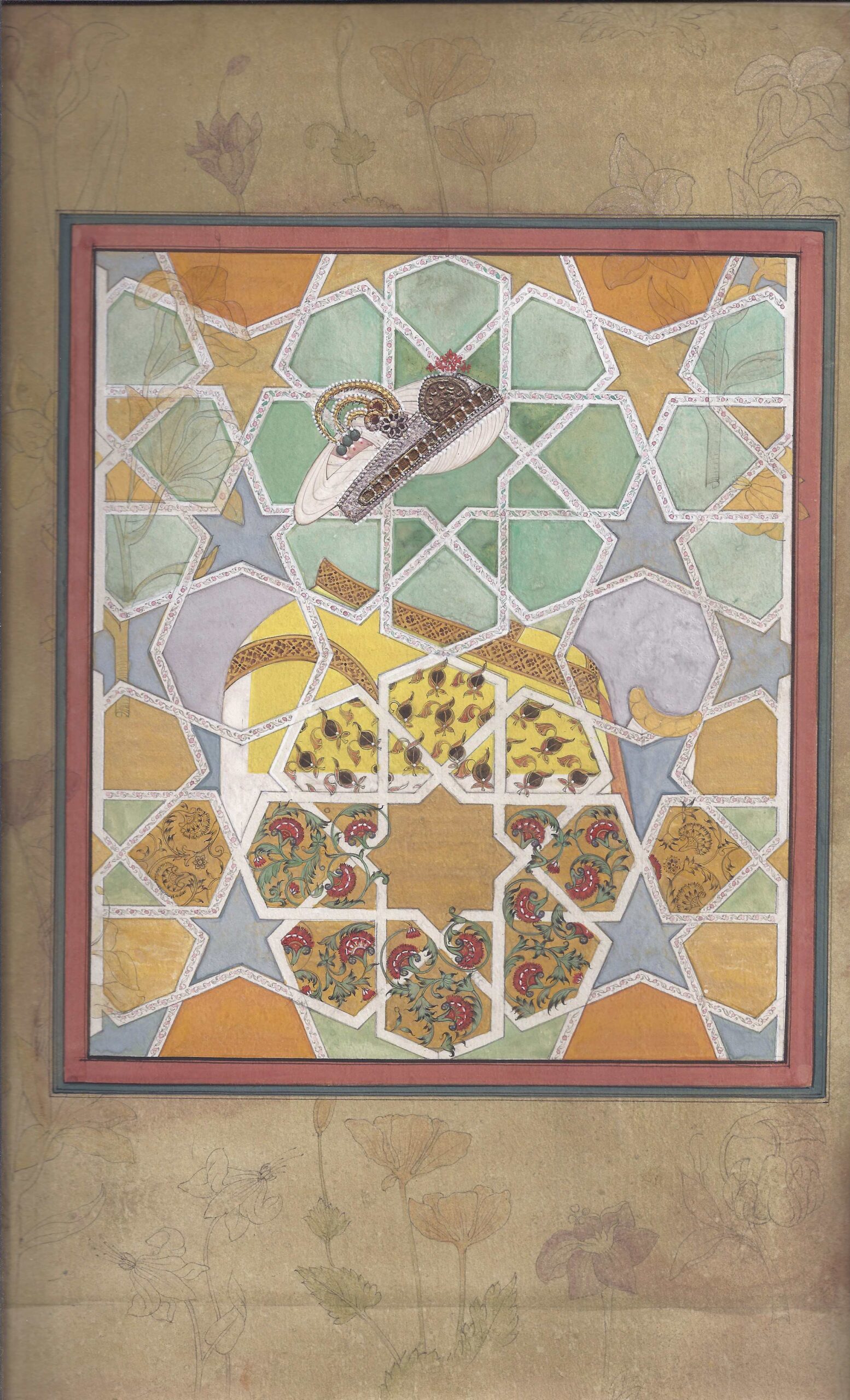
Vinit Sharma, Untitled, Waterbased colour on Indian Wasli Handmade
When questioned about her favourite element in miniature painting, she replies with great joy that it lies in the rich detailing – she loves the minute and painstakingly developed patterns – on a sword, a dress or carpet; the delicacy of line and the luminosity of colour that complement each other to make a vibrant whole. She explains how intrinsic the natural pigments and time intensive techniques are to the results, and the manner in which she and Ajay Sharma strive to continue the long-standing practices, even when organic materials (like Khadia or alabaster clay) have become scarce and harder to come by. With their expertise, together they teach workshops on miniature painting, invited to universities and museums both in India and abroad.
Geometric design is another fascination for Vinita. Having spent extended time hosting workshops in West Asian nations, she has used her inspiration from Islamic architectural elements and combined it with her knowledge of distinctive Mughal patterns in order to construct compositions that are as playful as they are compositionally balanced. In a current series of paintings on Kabir, she includes the celebration of the festival of Holi, utilising the structures offered by the geometric designs to create intuitive figurative scenarios.
Exploring the sensitive subject of physical distance and longing, another very popular series of works by her picturises the emotional status of every would-be grandparent awaiting the arrival of a grandchild in a far-away land. Expanding into a wider narrative of domestic spaces, she has painted naughty children, disobedient pets, and preoccupied mothers in these tableaus of love, imbuing the portraiture with a distinctive sweetness and producing interesting detailing such as trees filled with patterned motifs rather than leaf forms.
In her work, factual experience finds form in imaginary storytelling and vice versa, and her image-making process moves freely between varied vocabularies of the miniature, uniting the regional and global, and bringing the past and present together in seamless rhythm.
The Chronicler
Resonating with a methodology and visual practice similar to that of Vinita Sharma, Mainaz Bano has developed a unique style that positions her work within the city of Lucknow, where she is based. Surrounded by Indo-Islamic architecture, and the once renowned ‘ganga-jamuni tehzeeb’ a syncretic culture that speaks of the confluence of the rivers as well as people, their language, beliefs and practices – Mainaz has continually absorbed and chronicled elements from this experience. The worlds she paints are inhabited by characters that traverse historical and contemporary narratives, building bridges between personal observations, popular culture and socio-political realities. For her, the past is what makes the present possible and relevant, and therefore research forms a strong part of her process.
In love with painting and drawing from her childhood, Mainaz was drawn to the aesthetics of miniature painting in her school years, at first diligently making copies and later going on to pursue it while earning a Masters degree in creative landscape painting. Though she trained in the use of traditional pigments, she turned to the use of acrylic on canvas as she began to make larger works. Her compositions make lyrical use of space, colour and line, juxtaposing areas of intricate detail with vacant or minimally handled sections within which objects, flora-fauna and figures emerge; she compares this visual arrangement to the pace of life, that needs pauses amidst the chaos in order to understand oneself and move forward in a balanced way.
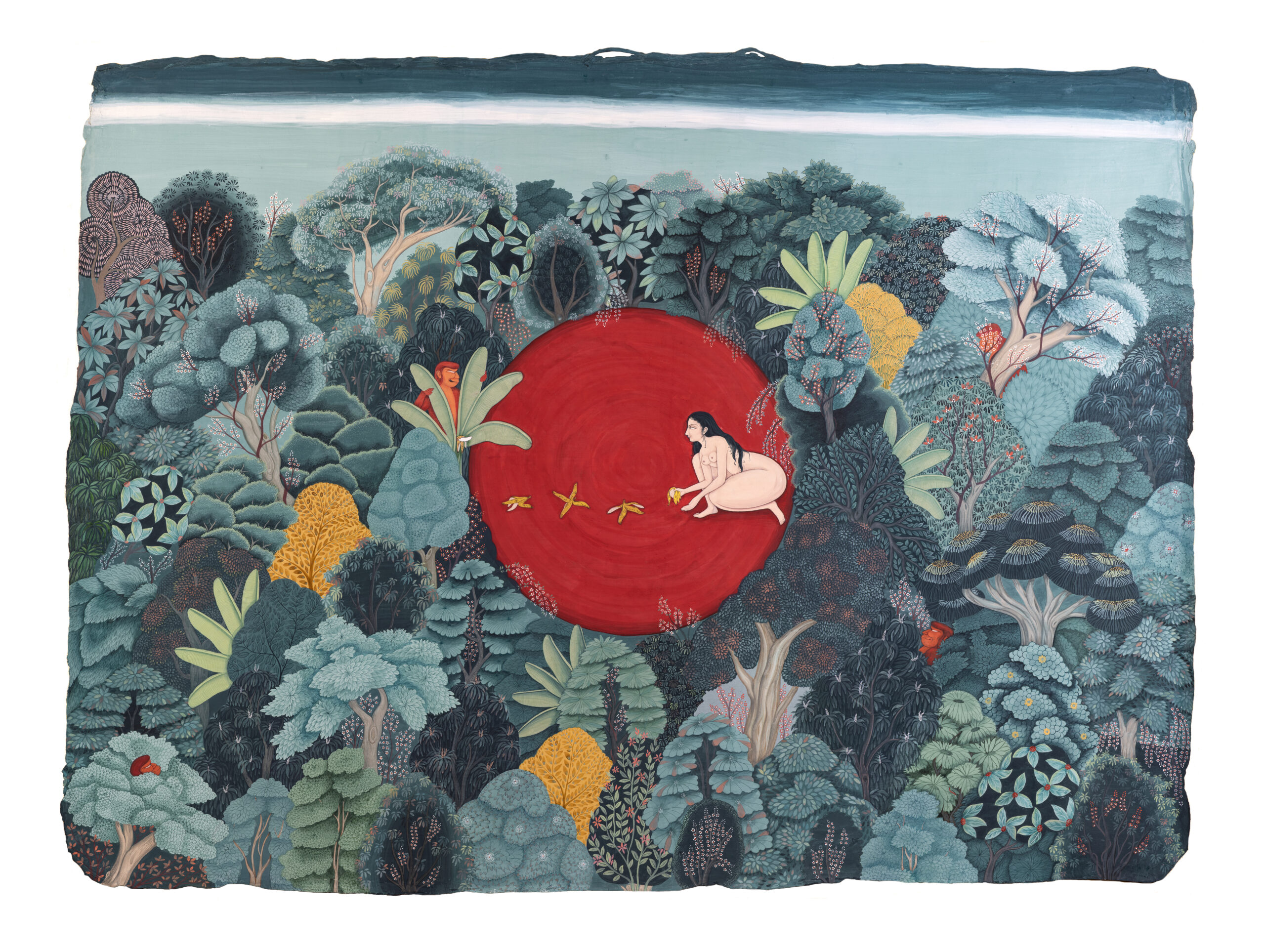
Gargi Chandola, Treasure Hunt, Gouache on Wasli.
An unusual and ambitious painting in her repertoire is ‘Evolution 2’, wherein she includes her self-portrait, seated at a table with the (in)famous Begum Samru, a catholic convert who started her life as a nautch girl but navigated her circumstances to become a powerful mercenary ruler in the region of Sardhana, in the early nineteenth century. Deeply intrigued by stories of women such as her, Mainaz presents a translated version of an earlier court miniature ‘Begum Samru and her household’ (circa 1820, Delhi, Chester Beatty Library). The ninety-five animated figures represent historical characters as well as her friends and several others known in Lucknow society. The environment opens out into the distinctive Mughal Charbagh, with the University Library as the backdrop and a modern street in the foreground. Deeply philosophical about the human condition, she employs linear forms as a device to comment on life’s transitions and its incompleteness; she also infuses her scenes with elements of humour, invoking the absurd alongside the solemn.
The Critic or the Learner
Humour and satire also form an essential visual and conceptual layer in Gargi Chandola’s versatile practice. Significant in her recent body of work is a series of miniatures that include the presence of Rhesus Macaques, a species of monkey indigenous to the forested areas of the Aravali mountain range where the artist resides. Sometimes relegated to the richly pigmented borders, and at others paired with the Nayika within a lush landscape, these creatures embody behaviours that offer parallels to human nature, demonstrating greed and desire, aggression and dominance, and the will to survive, among other things.
As seen in works like ‘Treasure Hunt’ and ‘Purge’, the Nayikas appear fully in control of their wants and nonchalantly take charge of their surroundings. While a certain sexual symbolism carries forward the commentary on gender hierarchies and power play, the Nayika’s themselves transcend objectification, representing instead the wisdom and playfulness, the resilience and righteousness of the Woman in plurality. Here is a being who embraces and envelopes the multilayered quality of feminine existence, that Gargi says comes from her own deep relationships with all the women in her extended family.
While being connected to creative making from her childhood, Gargi found her calling as an artist after having trained in the guru-shishya parampara to learn the techniques of Basohli, Pahari and Kangra schools of painting. Deeply interested in the pursuit of traditional art forms, she recently took time to teach herself the challenging technique of Turkish ebru-marbling on paper, a process that she is now experimenting with to represent the rugged rock formations that are so much part of her home environment.
Miniature painting, which may have experienced a low period a decade or two ago, is riding on a good wave now. As Vinita Sharma shares, a lot of artists from the younger generations are investing time and energy in learning these old and trusted techniques, often reframing them to fit within personal contemporary explorations.
Vinita Sharma, Mainaz Bano and Gargi Chandola may have never met, but their works connect and share common space, bringing varied perspectives, thoughts and ideas to this dialogue. Womanhood is never singular or fixed, nor is the expression of it. Every sketch, every composition holds multiple stories, mythologies and lived experiences. The individual voice carries the resonance of multiples.
She is the mother, the nautch girl, the matriarch
The black sheep and the white, the found and the lost,
She encompasses all
She belongs. She is.