

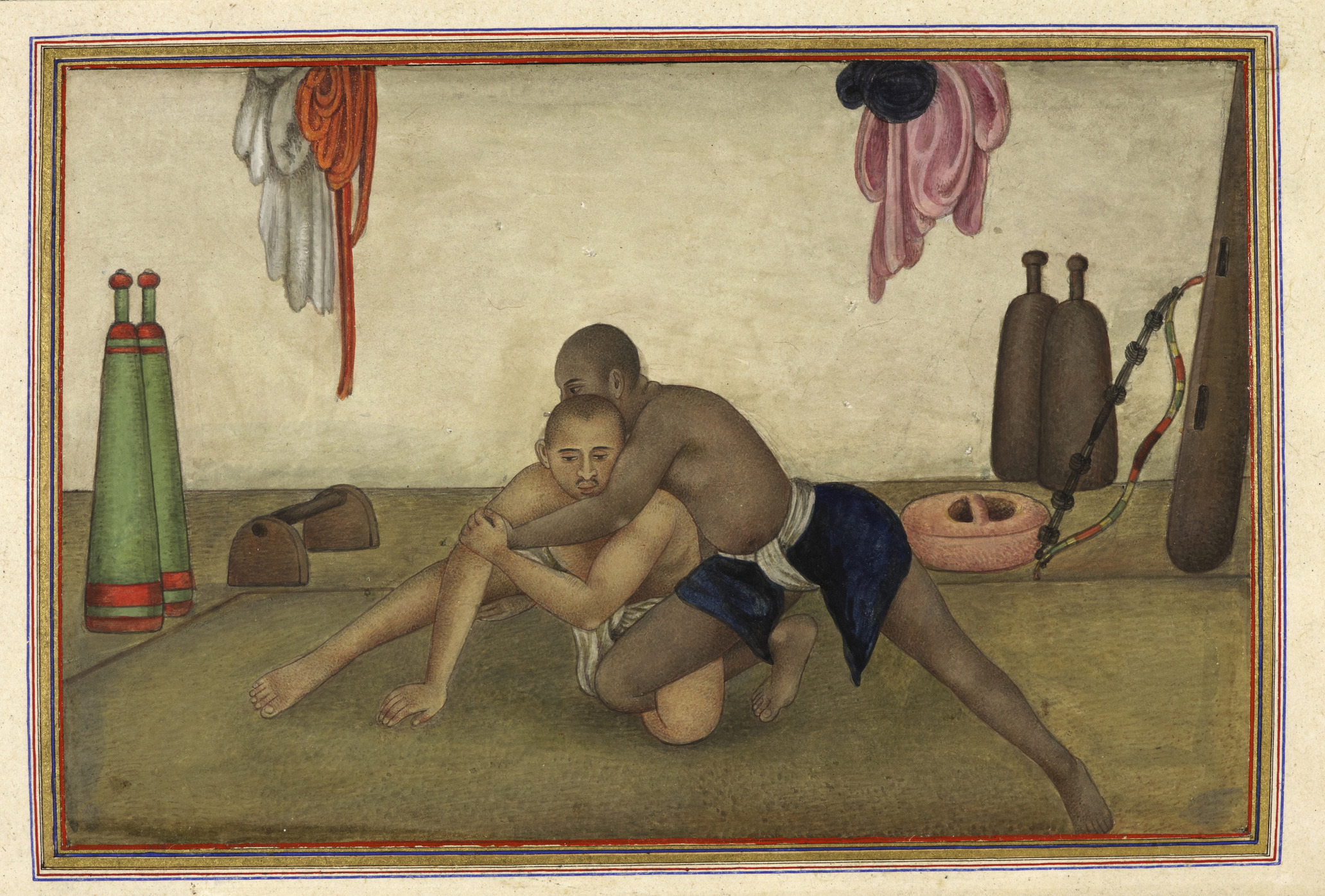
Ghulam Ali Khan, Two Men Wrestling, Tashrih-al-Aqvam, Gouache on Paper. 1825 AD.
The first thing one notices about an akhara is the earth. Carefully maintained—turned over, watered and sometimes scented—it forms the centre of the wrestling pit. Early in the morning, before the heat settles in, wrestlers step onto it barefoot. Some touch the ground before entering; others rub earth onto their arms and chest. The smell is distinctive: mustard oil, ghee, sweat and soil. Earth and bodies mingle in a way that feels almost consecrated. This is where wrestlers train, compete, exchange stories and spend long hours together. Outsiders rarely find their way inside. Akharas are not public spaces in the conventional sense but tightly knit communities held together by routines, hierarchies and a shared devotion to wrestling.
When we encounter wrestlers in Indian miniature painting, a different set of questions emerges. Who is looking at these bodies? What drew the artist’s eye? What did audiences see? Strength? Skill? Masculinity? Or something else entirely?
Looking at a nineteenth-century miniature depicting two wrestlers in practice, I am struck by something unexpected. The scene is deceptively simple. Two men are locked in a grappling hold while jori clubs and weights lie scattered about. These men clearly embody strength and physical discipline, yet there is remarkably little emphasis on muscle itself. What stands out is not the muscularity of the wrestlers but its relative absence.
Seen alongside other depictions of wrestling from the Mughal and colonial periods, the image points toward a broader visual tradition in which bodily strength was understood differently from how it often is today. Whether wrestlers appear grappling before Emperor Shah Jahan, entertaining courtly audiences, or training amidst clubs, weights and fellow practitioners, the emphasis rarely falls on the detailed rendering of muscular anatomy. The men are undoubtedly powerful, yet painters seem more interested in wrestling itself and the social worlds surrounding it. Wrestling appears simultaneously as discipline, spectacle, performance and patronage.
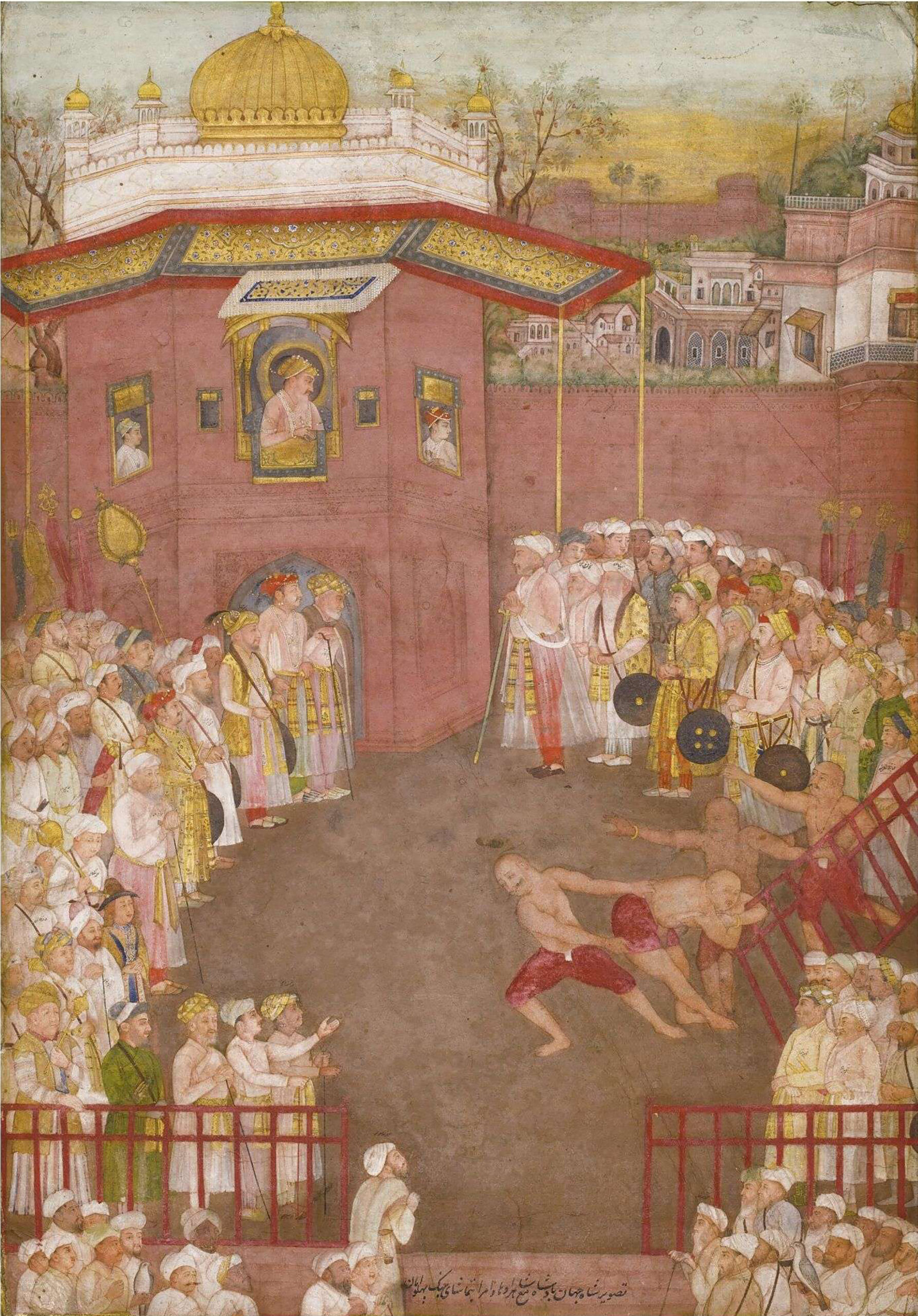
Mir Kalan Khan, Painting of the Mughal Emperor Shah Jahan Watching a Wrestling Match, Delhi or Lucknow. Gouache on Paper. 1750 AD.
Today fitness culture encourages us to associate strength with visible muscularity. Whether scrolling through Instagram, watching fitness influencers on YouTube or passing advertisements for gyms, we encounter bodies designed to be admired. Defined abdominals, broad shoulders and pronounced biceps have become visual shorthand for health and physical power. The wrestlers in these miniatures suggest a different ideal. Their bodies appear compact and functional rather than sculpted for display. What matters is not appearance but action. The emphasis falls on movement, leverage, balance and technique. Strength resides in what the body can do rather than how it looks.
Historically, Indian wrestling cultivated a distinctive understanding of bodily development. Wrestlers trained intensely and followed demanding routines of exercise, diet and discipline. They sought endurance, resilience and stamina alongside strength. The goal was not simply to build a body but to cultivate a particular way of life. The training equipment depicted in miniature painting points toward this broader world. Indian clubs, or mugdars, have long been associated with wrestling traditions. During the nineteenth century they travelled far beyond South Asia, becoming popular exercise tools in Europe and North America before largely disappearing and then recently returning through contemporary fitness culture. What appears innovative is often a reworking of much older practices.
Yet the relationship between wrestling and bodybuilding is far from straightforward. Wrestling has undoubtedly shaped broader ideas about masculinity, discipline and physical strength in India. Throughout the twentieth century wrestlers became symbols of masculine achievement and national pride, while physical culture movements drew inspiration from wrestling traditions alongside influences from Europe and North America. At the same time, wrestling and bodybuilding do not produce identical bodies.
The wrestler’s physique emerges through grappling, swinging clubs, performing dands and baithaks, and training with opponents. Fitness and bodybuilding place far greater emphasis on the visual presentation of the body. It would be a mistake, however, to imagine that kushti wrestling has remained unchanged. Nowhere is this transformation more visible than on social media. Many younger wrestlers maintain active Instagram and YouTube accounts where they document training sessions, share dietary advice and post carefully composed photographs of their physiques. The body has become something to be viewed as much as something to be used. Visibility now matters in ways that would have been unfamiliar to the wrestlers depicted in older paintings. As a result, the physiques displayed by many contemporary wrestlers increasingly resemble those associated with bodybuilding.
Looking back at these paintings reveals not only how wrestling has changed but also how our ways of seeing bodies have changed. In one image wrestlers perform before a royal audience; in another British soldiers and Indian spectators observe demonstrations of physical training and martial exercise. Together these scenes remind us that wrestling was never simply about individual bodies. It connected rulers and subjects, teachers and pupils, spectators and performers. Strength derived meaning from these relationships rather than from the isolated display of muscle.
The wrestlers in traditional miniature paintings are presented differently from the bodies that dominate contemporary fitness culture. Their physiques matter, but they are rarely the central subject. Attention is directed instead toward movement, technique, ritual and the communities gathered around these practices. What emerges is a vision of strength that is fundamentally relational rather than individual. The muscular body was certainly present, but it had not yet become the primary object of attention that it would later become in the worlds of bodybuilding, fitness culture and social media.
Bibliography
- Alter, Joseph S. 1993. “The Body of One Color: Indian Wrestling, the Indian State, and Utopian Somatics.” Cultural Anthropology 8(1): 49–72.
- Alter, Joseph S. 2000. “Subaltern Bodies and Nationalist Physiques: Gama the Great and the Heroics of Indian Wrestling.” Body & Society 6(3–4): 45–72.
- Baas, Michiel. 2020. Muscular India: Masculinity, Mobility and the New Middle Class. New Delhi: Context/Westland.
- Baas, Michiel. 2024. “The Muscular Body in Public Space: Masculinity, Middle-Classness and the ‘Urban Villagers’ of Delhi, India.” Boyhood Studies 17(2): 65–85.
- Gupta, Abhijit. 2012. “Cultures of the Body in Colonial Bengal: The Career of Gobor Guha.” The International Journal of the History of Sport 29(12): 1687–1700.