

Humans have always generated waste but there is a distinct quality to the kind of waste we have generated since the invention of plastic: waste that does not return to life, waste that fills the land and floods the oceans. It can break down to the point of invisibility but it still lingers at micro and nano scales. The ubiquity of plastic is such that it has been traced in placentas and breastmilk. That is to say that capitalism and its extractive technologies, which rely on oil and its by-products, have reshaped not only our landscapes but also altered the constitution of our bodies.
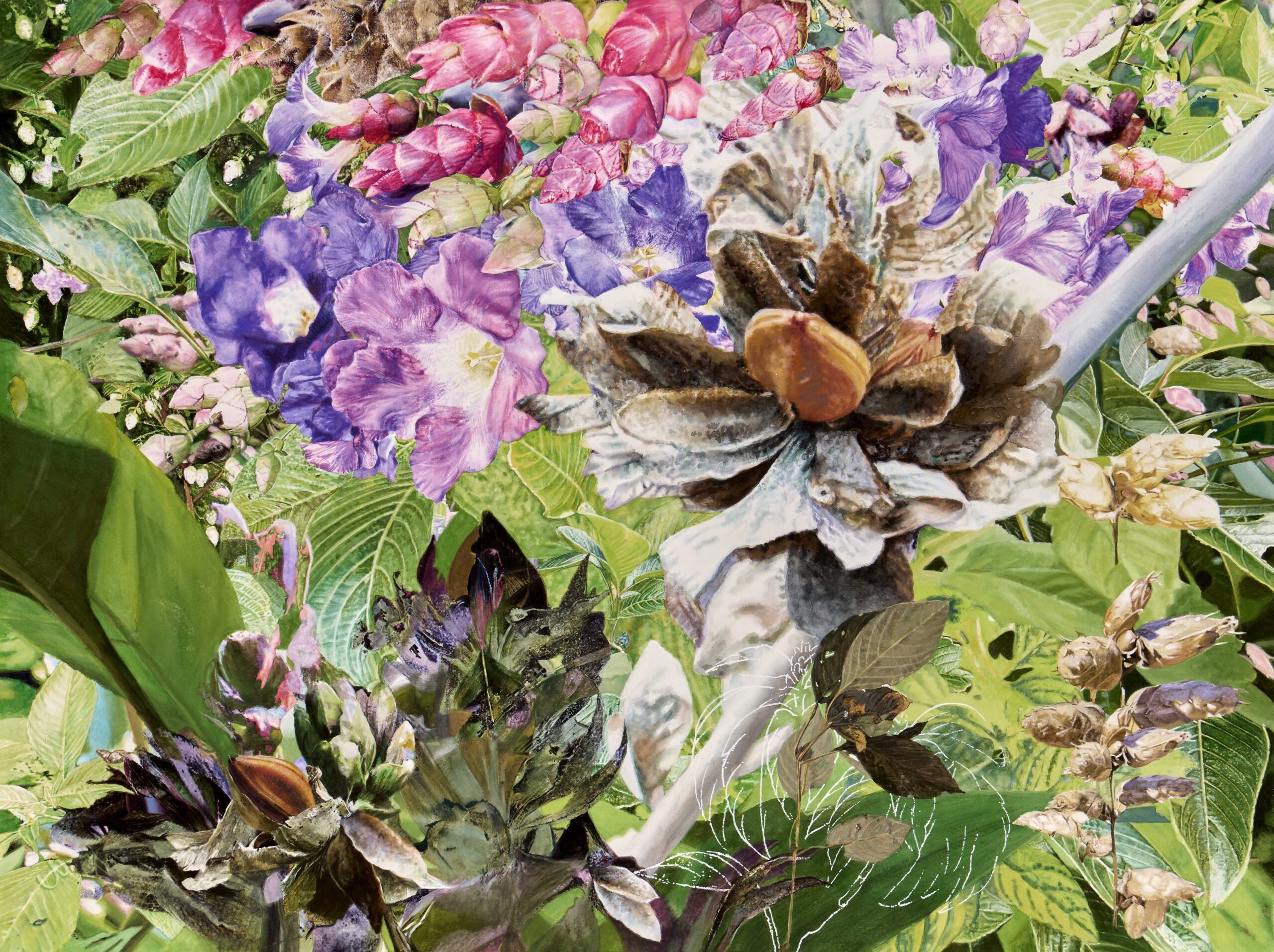
Navjot Altaf, Karvy, Strobilanthes Callosa; Waste Archives as Landscape, 2025, Courtesy the artist and Volte Gallery
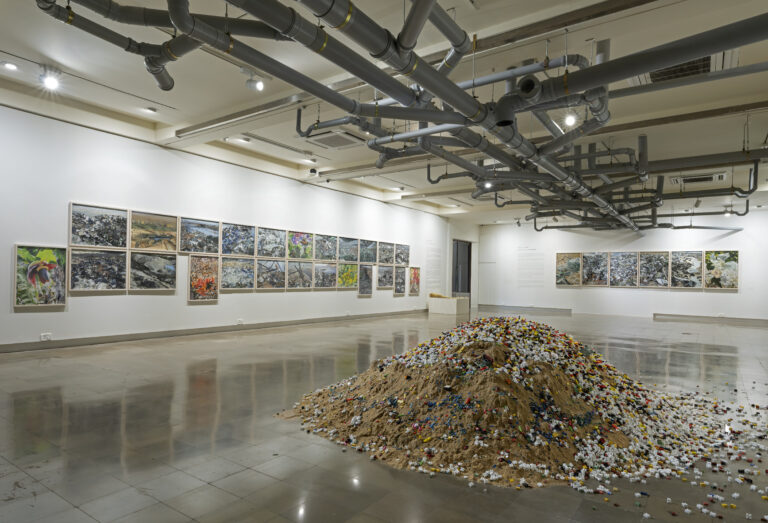
The disturbing experience of encountering a mound full of electronic waste amidst a forest, next to a watering hole visited by a herd of elephants, led artist Navjot Altaf to conduct field visits to larger landfills on the outskirts of cities like Mumbai and Ahmedabad. This new direction in her practice has its roots in her work around mining and loss of land and life in Chhattisgarh, which she has documented since the 1990s. Shifting focus over the last two years, Altaf produced paintings, a video, and an installation to highlight the unequal burden of toxic waste in the marginalised areas and communities. These works were exhibited in Mumbai in Waste Archives as Landscape.
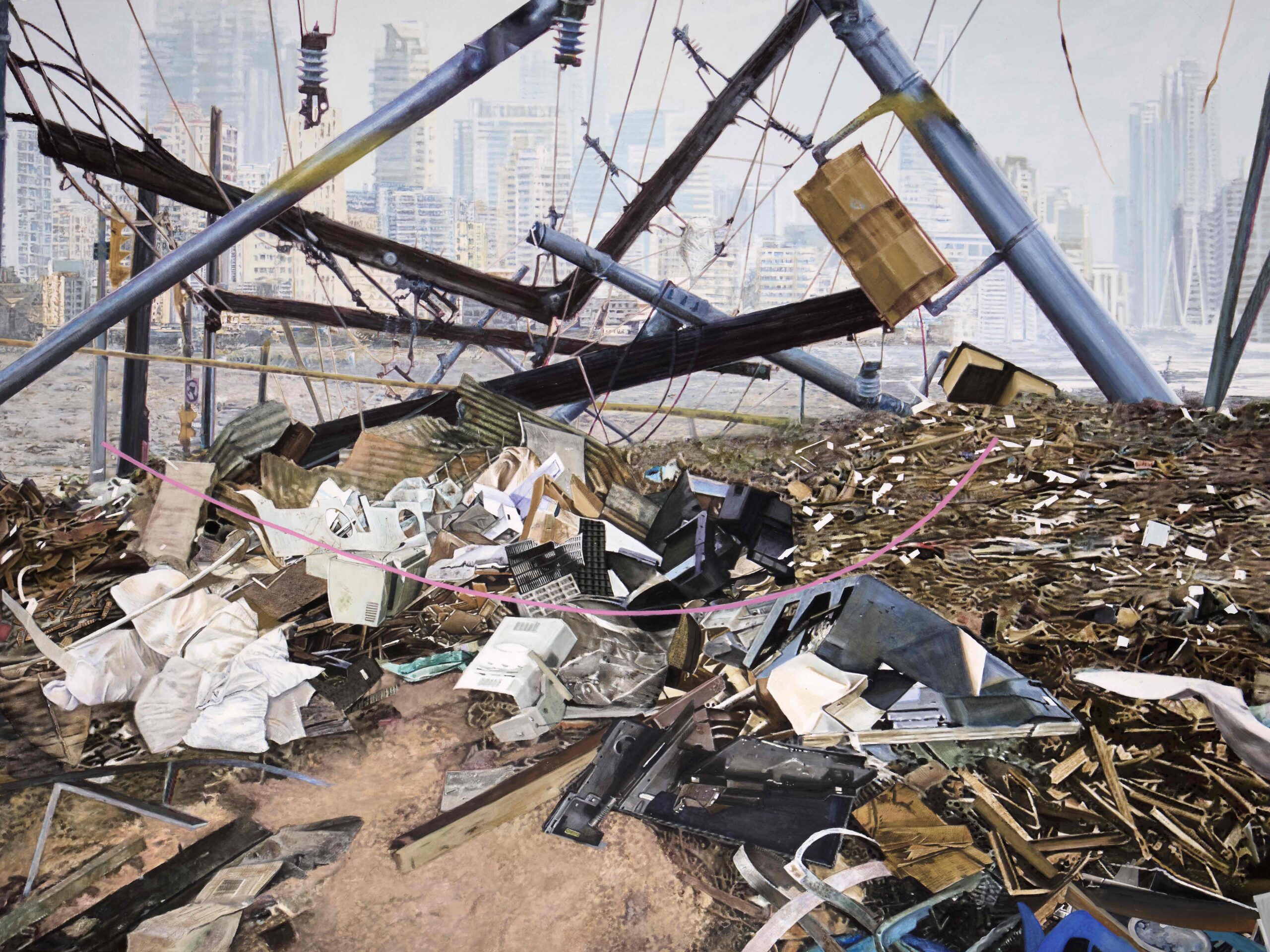
The exhibition takes its title from a series of gouache paintings, which assemble fragments of images of various landfills located in India and elsewhere. From a distance, some of the paintings show a wide view of garbage-filled areas on the fringes of settlements but most of them depict undistinguished heaps: an emphasis on their gradations of colour rather than objecthood. In this latter set, a few parts of machines or pieces of structures emerge when the eye leans in but there is otherwise an overload of detail making us hover over the surface, darting here and there, unable to anchor ourselves. Parts of the route of Khian Sea, a ship filled with 14,000 tons of ash from Philadelphia, are traced on the paintings in the form of abstract lines. Altaf’s interest in Khian Sea’s journey – wandering for two years between 1986 and 1988 before dumping near Haiti, and in the waters between Singapore and Sri Lanka – comes from the illegal transfer of waste to less powerful countries, which continues to take place and is increasingly legally sanctioned.
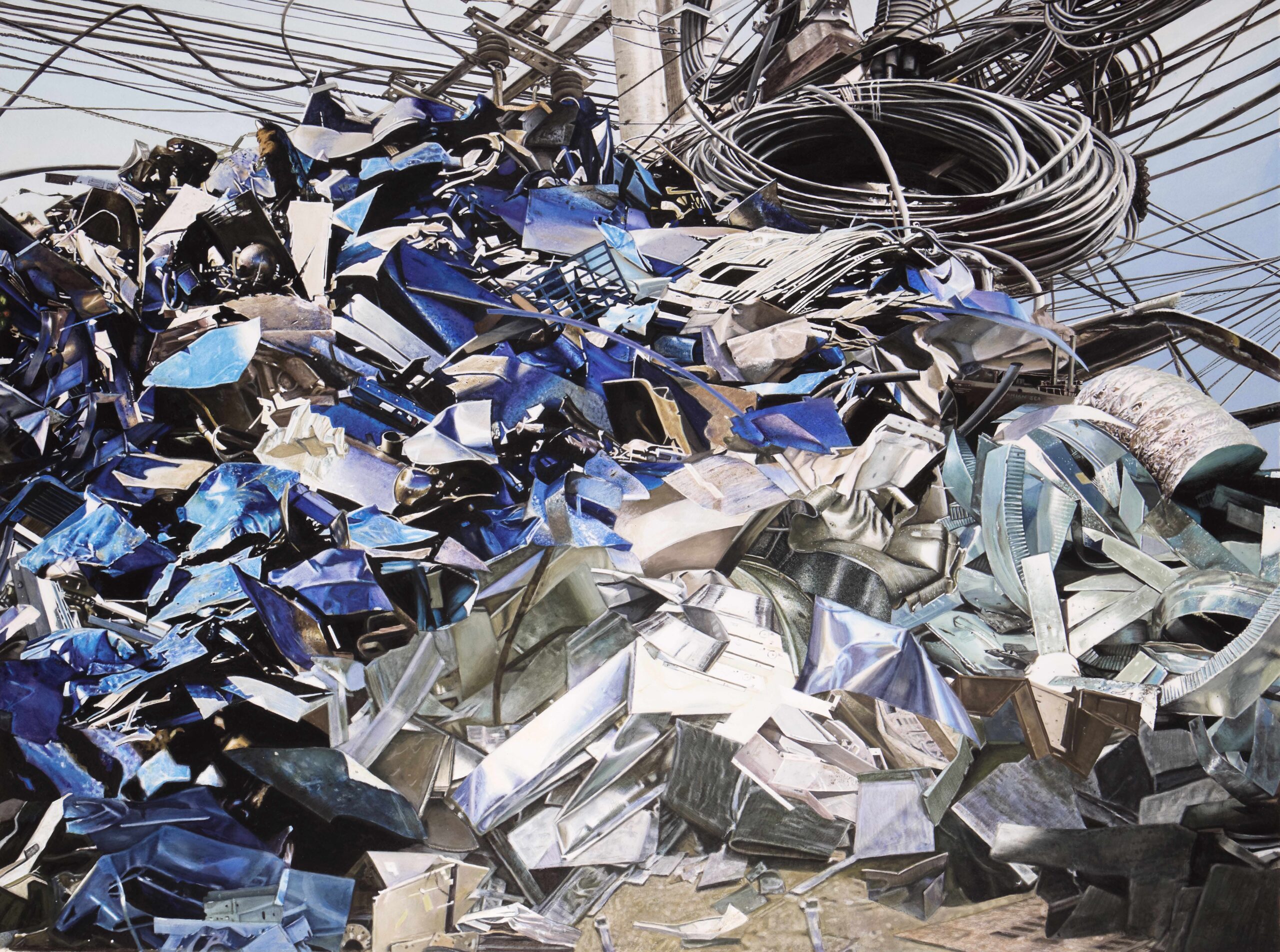
Navjot Altaf, Waste Archives as Landscape, 2024-25, Courtesy the artist & Volte Gallery
The collective title of the paintings, Waste Archive as Landscape, suggests they are meant to be archives. If so, they are archives that are out of reach, whose contents cannot be discerned. Perhaps this effect is a reference to the impact of the limitless cycles of production of products that humans cannot entirely grasp or catalogue. On the contrary, those who live on the edges of landfills, both humans and nonhuman living beings, suffer the consequences viscerally. The reality is not distant and the horrors are inescapable. The sensing of such an atmosphere of horror comes through in the short video Instinct, 2024–2025, in which a dog ambles over a landfill. Since it is a scene reconstructed through animation there is an aura of nightmare hovering over it. Smoke rises in the distance. The dog walks from one end of the frame to another, without much force or intention, stops to vomit towards the end of the trajectory before disappearing. Although we cannot distinguish the waste the dog is surrounded by, we can gather that it is toxic, that it has undone something in the animal’s being, and that it has altered its fate. As we watch this scene unfold over a few minutes, the dog comes to be demarcated as a victim of its circumstances despite having played no role in the generation of the waste that has poisoned its body.
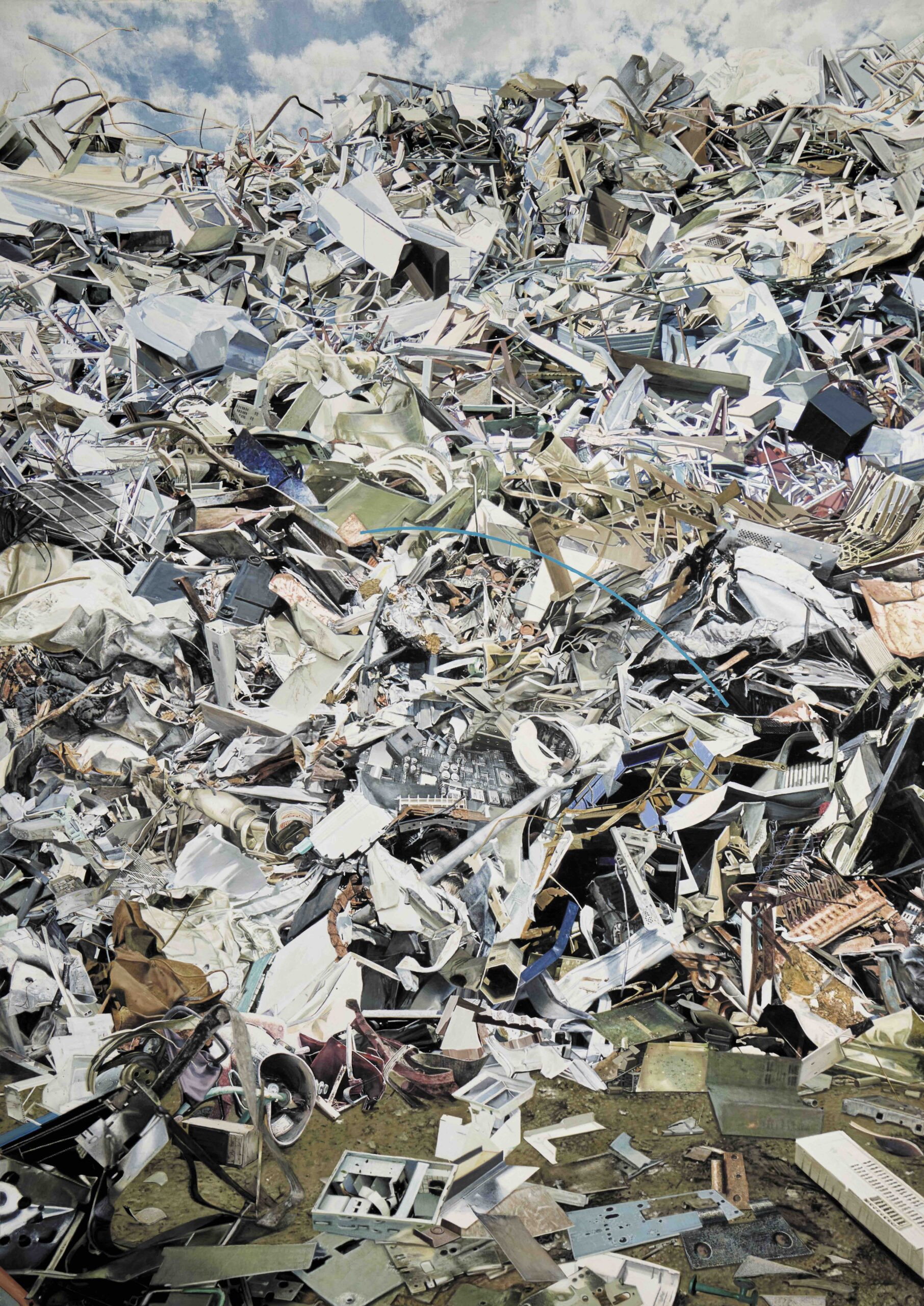
Navjot Altaf, Gudhal/White Hibiscus, Hibiscus Arnottianus; Waste Archives as Landscape, 2024-25, Courtesy the artist & Volte Gallery
Elsewhere, footage of thriving plants and lush waterfalls forms the backdrop to a discussion on the caste-based politics of land theft in Chhalbal, 2024-25. In this 35-minute video, four actors from Ahmedabad-based Budhan Theatre present a Dalit perspective on the myth of Durga. Through a didactic discussion, they question the supposed feminist agency of the Hindu goddess, whose act of slaying Mahishasura reinforced Brahmanical supremacy. Much of the argument is based on the book Mahishasur: Ek Jannayak, edited by Pramod Ranjan, but the video extends the context to the present with a reference to the clashes among students at the Jawaharlal Nehru University in New Delhi over a commemoration gathering for Mahishasura. The video notes how indigenous or adivasi world views, which advocate harmony and balance between land and living beings, stand in opposition to patriarchal and capitalist ownership models which place the extractive human at the centre of their ideologies. With its instructive dialogues, the video functions like an essential accompanying text to outline the conditions of injustice emerging from supposed progress and development in India. Perhaps, a direct evocation of local or national infrastructures of waste and their relationship to global networks of capital would have enriched the discourse presented in the work.
Navjot Altaf, Waste Archives as Landscape, 2024-25, Courtesy the artist & Volte Gallery
These ideas are explored through metaphor in the site-specific installation Take-Make-Waste, 2026 in which a network of PVC pipes fixed to the ceiling spews out chips used in electronic machines whenever a visitor walks by. In the background, sounds of planes and meditation bowls mount a contrast between their individual use of metals. Although meant to illustrate the manner in which waste fills up and pollutes the earth, there is a playful aspect to the installation that turns it into a game for the visitor. Complicity does not feel concerning because the parts that emerge from the pipes appear new with a shine, no less enticing than LEGO bricks. There is a sense of possibility to them as functional objects, arrested here in the form of an installation, which may be quite different from the qualities of e-waste when it begins to disintegrate and release toxic chemicals into the environment. As the proportion of dumped e-waste grows faster than any other solid waste stream in the world, the necessity to grasp this fact and its consequences is important even if its dimensions grow larger than the human capacity to imagine. Perhaps, art can provide expressions to these concerns in concrete form. But the installation leaves us wondering: how can the subject of e-waste be tackled in art in a way that captures the environment it creates, the impact it has, and the unequal burden of its creation and disposal?
Navjot Altaf, Waste Archives as Landscape, Curated by Puja Vaish, 12 March – 10 June 2026, Jehangir Nicholson Art Foundation.