

Blue coiffed hair, a ballgown, and cocktail gloves—Mademoiselle MIMOSA, the alter ego of Oat Montien, opened Thailand Biennale Phuket 2025 with an animated performance of “Diamonds Are a Girl’s Best Friend”. The theatrical vernissage set the tone for a biennale that oscillates between spectacle and historical reflection.
Titled “Eternal [Kalpas]”, the fourth edition is led by artistic directors Arin Rungjang and David Teh, with curators Hera Chan and Marisa Phandharakrajadej. Organised by the Thailand Office of Contemporary Art and Culture in partnership with the provincial government of Phuket, the programme spans 20 venues and 13 independent pavilions, bringing together 65 artists and collectives, along with more than 50 new commissions. Disused industrial facilities and civic spaces serve as venues, folding Phuket’s histories of extraction, tourism, and urban transformation into the biennale’s spatial narrative.
Ayoung Kim

Ayoung-Kim, Surisol Underwater Laboratory, 2020.
In the speculative universe constructed by Ayoung Kim, fiction becomes a framework for examining the entanglements of technology, migration, and the posthuman condition. At the biennale, she presents three works: “Surisol Underwater Lab”, “The Underwater Response”, and the newly commissioned installation “A Shade for Surisol Underwater Lab”.
While the videos “Surisol Underwater Lab” (2020) and “The Underwater Response” (2021) were produced earlier, Kim chose to intervene in the site through a new architectural element. “I wanted to intervene in the space using photo blinds and some darker elements. I wanted to work with the existing elements of the site,” she explains.
The narrative unfolds within a fictional underwater research facility overseen by an artificial voice named Surisol. “‘Surisol Underwater Lab’ is a fictional place that I imagined in 2020. It’s an underwater lab, really. It’s on the shallow seabed. In this lab, giant seaweed is cultivated in order to turn it into biofuel,” Kim notes, adding that the premise is grounded in real ecological possibilities.
Installed in the final chambers of the Municipal Gymnasium, “A Shade for Surisol Underwater Lab” takes the form of a trompe-l’œil window blind printed with a scene from the fictional lab’s environment. Acting as a threshold between architecture and image, the installation extends the Surisol universe into physical space, framing the speculative underwater landscape as a site where questions of climate crisis, technocracy, labour, and migration converge.
Venue: 4000-seat Municipal Gymnasium Bangkok Road, Talat Nuea, Mueang Phuket, Phuket 83000
Wu Chi-Yu

Wu Chi-Yu, Stories of Celluloid: The Exhibited Factory of Cinema, 2025.
Taiwanese artist Wu Chi-Yu traces the hidden material histories behind moving images by linking the development of cinema to colonial resource extraction. In his ongoing project “Stories of Celluloid”, the key protagonist is camphor, a substance derived from trees native to East and Southeast Asia and once essential to producing flexible celluloid film stock. In the chapter “Useful Plants”, set in the mountainous regions of Taiwan where camphor trees still grow, a traditional labour song about camphor distillation gradually shifts into verses voiced from the tree’s perspective. The work reflects on how imperial powers catalogued colonial landscapes according to their industrial usefulness, building vast databases of natural resources.
Wu suggests that this logic of organising knowledge persists today in artificial intelligence systems, where algorithms structure enormous datasets through coded commands. Yet he also experiments with AI as a creative tool, incorporating AI-generated imagery of camphor trees to rethink and transform colonial archives. A subsequent chapter, “Useful Cinema”, is filmed in a rubber plantation in Phuket. Blending archival references and instructional film aesthetics, Wu reveals how both human labour and natural materials were shaped by extractive economies while also hinting that new relationships and interpretations can emerge from these histories.
Venue: Former Kathu Liquor Distillery, Excise Department, Wichit Songkhram Road, Kathu, Phuket 83120
Ryuichi Sakamoto with Shiro Takatani

Ryuichi Sakamoto with Shiro Takatani, Is Your Time. 2017-2024.
At the centre of a darkened gymnasium sits a piano resting in a shallow basin of water. Above it, a screen quietly shows snow falling. This meditative installation, “IS YOUR TIME”, by Ryuichi Sakamoto in collaboration with Shiro Takatani, revolves around an instrument damaged in the tsunami during the Great East Japan Earthquake 2011.
When Sakamoto first encountered the piano in a devastated school gymnasium, he described feeling as though he had witnessed the “death of music.” Yet he also regarded it as a “piano tuned by nature.” The installation treats the instrument less as a tool for performance and more as a resonant object shaped by environmental forces. Drawing from compositions associated with Sakamoto’s album async, the work merges sound, light, and spatial perception to create what he described as “installation music”. In Phuket, an island still marked by memories of the 2004 tsunami, the damaged piano becomes both a memorial and medium, attuning visitors to the fragile relationship between human culture and the natural world.
Venue: 4000-seat Municipal Gymnasium Bangkok Road, Talat Nuea, Mueang Phuket, Phuket 83000
Pattanapong Montien, also known as ‘Oat Montien’
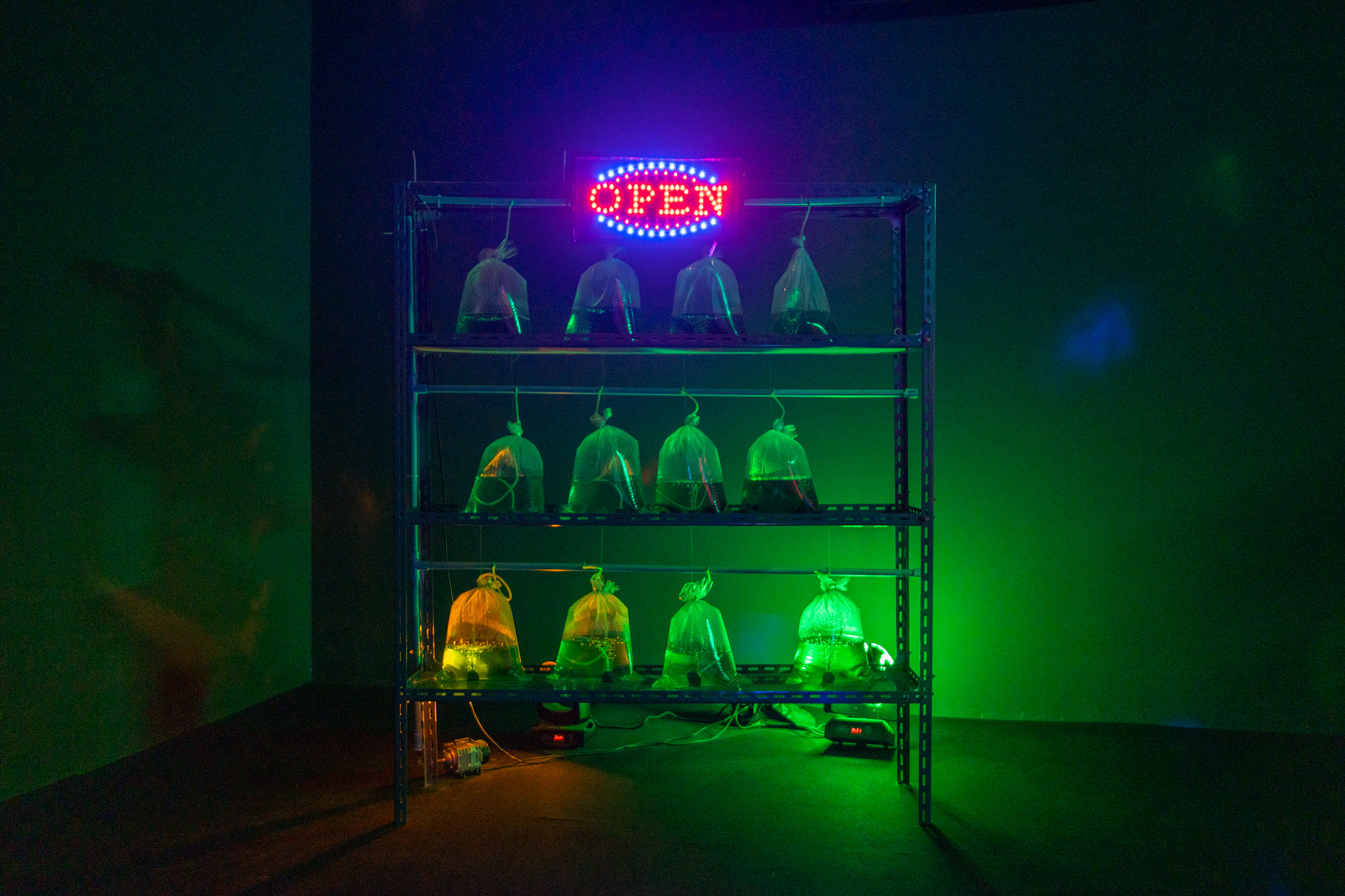
Oat Montien, Pearl, Boy, Operating, Theater, 2025.
The glow of neon-pink lights from a neighbouring work washes over a towering painting of a figure in a subtly slanted pose, beckoning visitors toward a curtain that opens into the world of Oat Montien, the alter ego of Mademoiselle MIMOSA. The artist has long been a voice for gender diversity in Thai society and beyond. His installation “PEARL BOY” brings together video, sculpture, and staged environments to explore the intertwined economies of nightlife, tourism, and pearl cultivation in Phuket.
Inspired by time spent observing the queer nightlife of Soi Paradise in Patong Beach alongside research into pearl farming, Montien draws a parallel between the biological formation of pearls and the social realities of the sex industry. Pearls form when an oyster coats an intrusive particle with layers of nacre—a defensive response that produces beauty from irritation. Montien likens this process to the emotional and performative labour of sex workers who mask hardship with glamour and charisma. Installed in the historic Pearl Theatre, a venue once associated with Phuket’s entertainment district, the work layers contemporary narratives of queer labour onto the building’s own history of spectacle and pleasure.
Venue: Pearl Theater, 163 Phangnga Road, Talat Yai, Mueang Phuket, Phuket 83000
Ariane Sutthavong

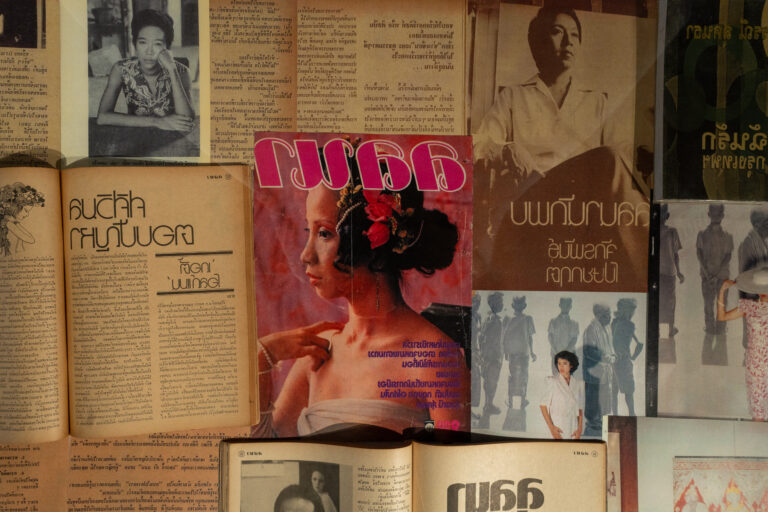
Ariane Sutthavong, Installation view, Thailand Biennial Phuket, 2025.
Curator and researcher Ariane Sutthavong examines the intersections of art, politics, and language through collaborative and archival practices. For the biennale, she revisits the cultural legacy of writer and editor Suwanni Sukhontha, whose influential women’s magazine Lalana helped redefine representations of femininity in Thailand during the 1970s.
Sukhontha, the author of more than forty novels and short-story collections, was often described using the phrases Than samai (“moving with the times”) and lam samai (“ahead of the times”). Through Lalana, founded in 1972, she cultivated a platform that brought together literature, visual art, fashion, and emerging voices in a rapidly commercialising media landscape. Sutthavong’s archival installation, staged in a former high-street bank, reconstructs the everyday material world of magazine production through fragments of editorial work, cover images, and historical ephemera. The presentation highlights how the magazine became a meeting point between literature, visual culture, and the changing image of the “modern woman” in Thailand.
Baan Turtle Phuket, Phra Aram Sakhonkhet Mansion, 78 Ranong Road, Talat Nuea, Mueang Phuket, Phuket 83000
Thailand Biennale Phuket 2025, 29 November 2025 – 30 April 2026. All Images Courtesy: The artist and Thailand Biennale.