

A sky full of twinkling stars is perhaps one of the earliest fascinations of human race. It is not difficult to imagine the first men, women, and children—who appeared approximately 3 million years ago—looking up in wonder with the setting of the sun and beginning to see guiding lights in the sky. Unlike modern age when light pollution of urban areas deprives us of a clear view of the vast universe, humans of yore were able to see heavenly bodies with great clarity, and named the sparkling river flowing across the night sky as Akash Ganga and the Milky Way. The mystery of the universe continues to fascinate us, as it is little explored despite great efforts, and is likely to remain so for a very long time to come.
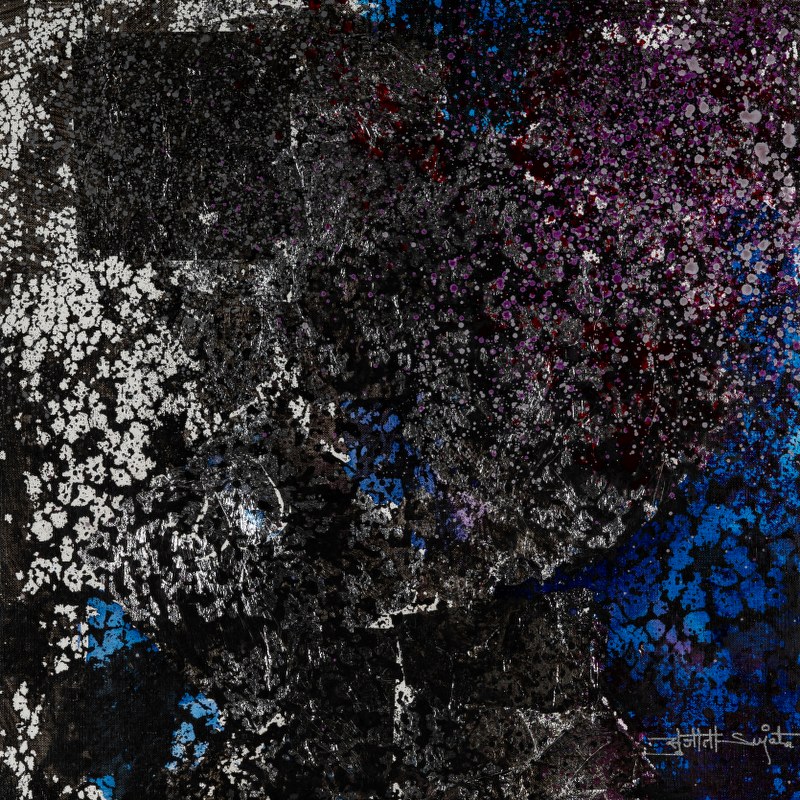
Spacescapes, Stardust Series.
Sujata Bajaj, the Paris-based abstractionist who carved a niche for herself in the genre long back, is a rare one among us whose fascination with the cosmos goes beyond the allure of its unfathomable depths. As an abstractionist, Bajaj finds many parallels between her art and the nebulous, protean, incomprehensible universe. She has chased the clear skies in different parts of the world, and lain under open sky at night in places that are hardly inhabited, only to gaze at those lights from afar. And while doing that, she has simultaneously transported the universe on her canvases to stunning effects. Spacescapes is Sujata Bajaj’s solo show in Delhi after a decade and showcases paintings that mark a significant departure from her previous work.
Talking about the genesis of this particular series, Bajaj says, “In 2019, I happened to come across a NASA image taken from the Hubble telescope, showing the Andromeda galaxy. I connected with the photograph without knowing what it actually was. The seed of ‘Spacescapes’ was planted. I understood that this journey would require the use of new techniques as well as experimentation. Thereafter, I explored other images taken from the James Webb telescope.”
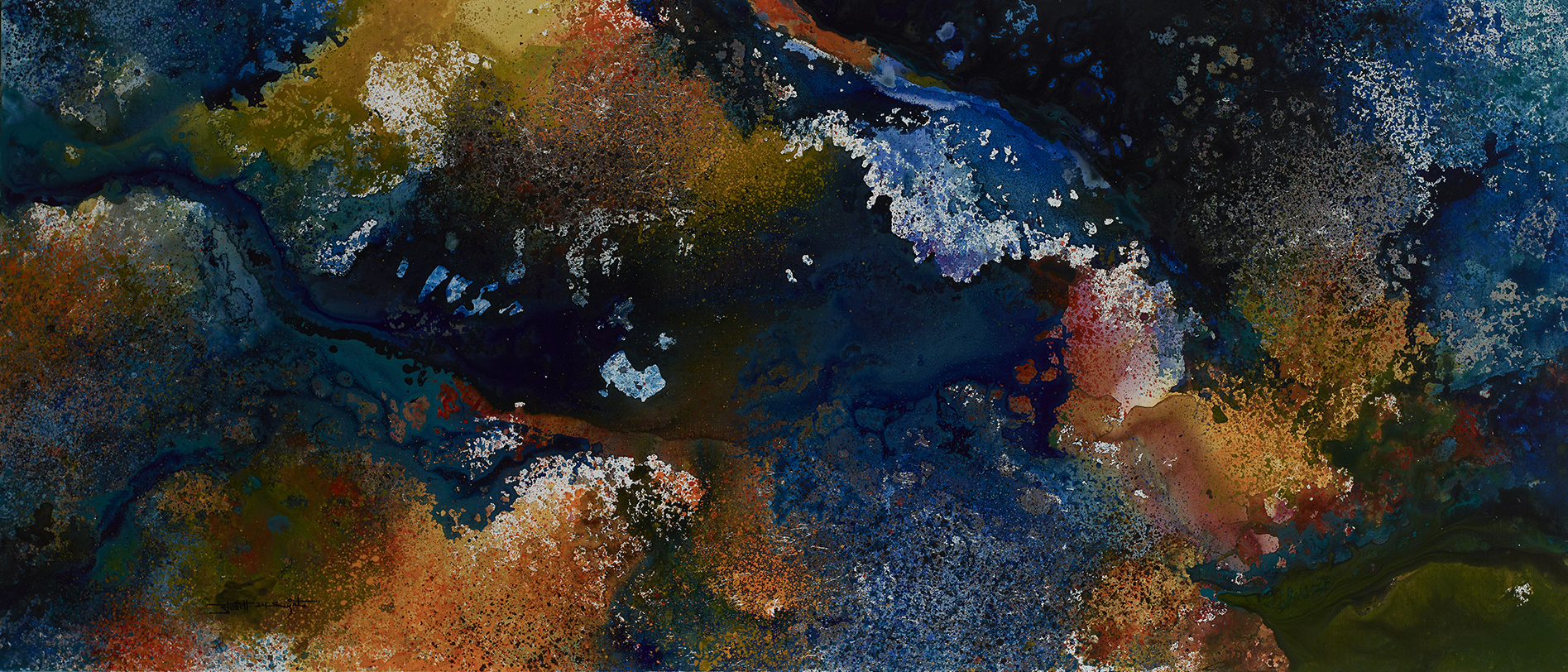
Spacescapes, Celestial River.
Bajaj spent the next five years studying the abstract reality of the cosmos, not just with wonder in her eyes but with a spirit of enquiry worthy of a scientific experiment. “After I seemed to have found what I was exploring, I worked like a person possessed, working 15 hours sitting on the floor. In due course I developed techniques through several experiments, whose results you see on the canvas,” she shares. A close examination reveals the immense layering that Bajaj has done on her canvases to make her ‘spacescapes’ appear like real slices of the universe. Bajaj informs that at some instances she created as many as 25 layers of fluids on the canvas in acrylic paint. The galactic mass of the universe thus created in her works, in multi-layered reds, greens, blacks, whites, ochres and more, seems to move as one stops to look closely; that is the power of Bajaj’s technique that the mass of gases and particles that she has created is alive and organic, just as it is out there beyond the skies. “The universe has no beginning and no end, and I was bent on creating that sensation in my works,” she affirms as she seems momentarily lost gazing into eternity through the galactic matter in her works.
“This series had me engrossed at another level. I’m also very grateful to have got such an inspiration. And yes, the images that the Hubble and James Webb telescopes have taken us to those reaches of the cosmos where astronomy had not reached earlier. Here, I would like to mention that I did not surf NASA images endlessly but looked at them only as an inspiration, as a vision of the horizons that we have not seen before,” explains Bajaj, who won a French government scholarship in 1988-89, and studied at École Nationale des Beaux-Arts, Paris, where she would soon settle down. Among other accolades, Bajaj won the prestigious Raza Award in 2003, and was a close acquaintance of the master (S. H. Raza), with whom she shared several conversations on painting over tea and lunches while he lived in Paris.
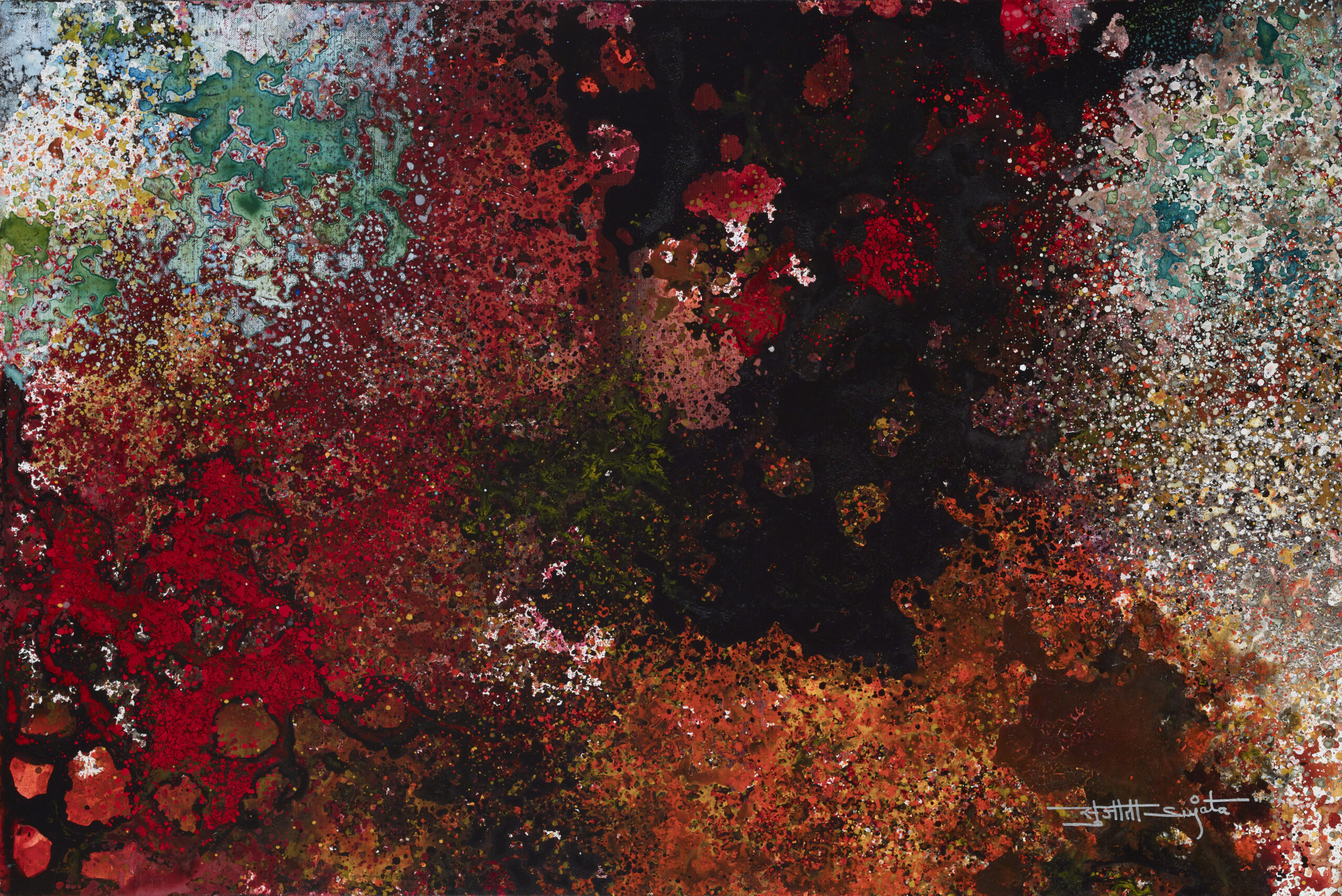
Spacescapes, Fission.
Given her diligence, which she has shown in ample measure since the start of her career—she pursued a PhD in Indian Tribal Art from S.N.D.T. University, Pune, only because she wanted to get better acquainted with indigenous art forms—Bajaj confabulated with scientists for this series, such as French astrophysicist and science popularizer David Elbaz (Directeur Scientifique du Département, d’Astrophysique, CEA Saclay, Paris), who has also written a very insightful text on her art for the publication that was released at the launch of the exhibition.
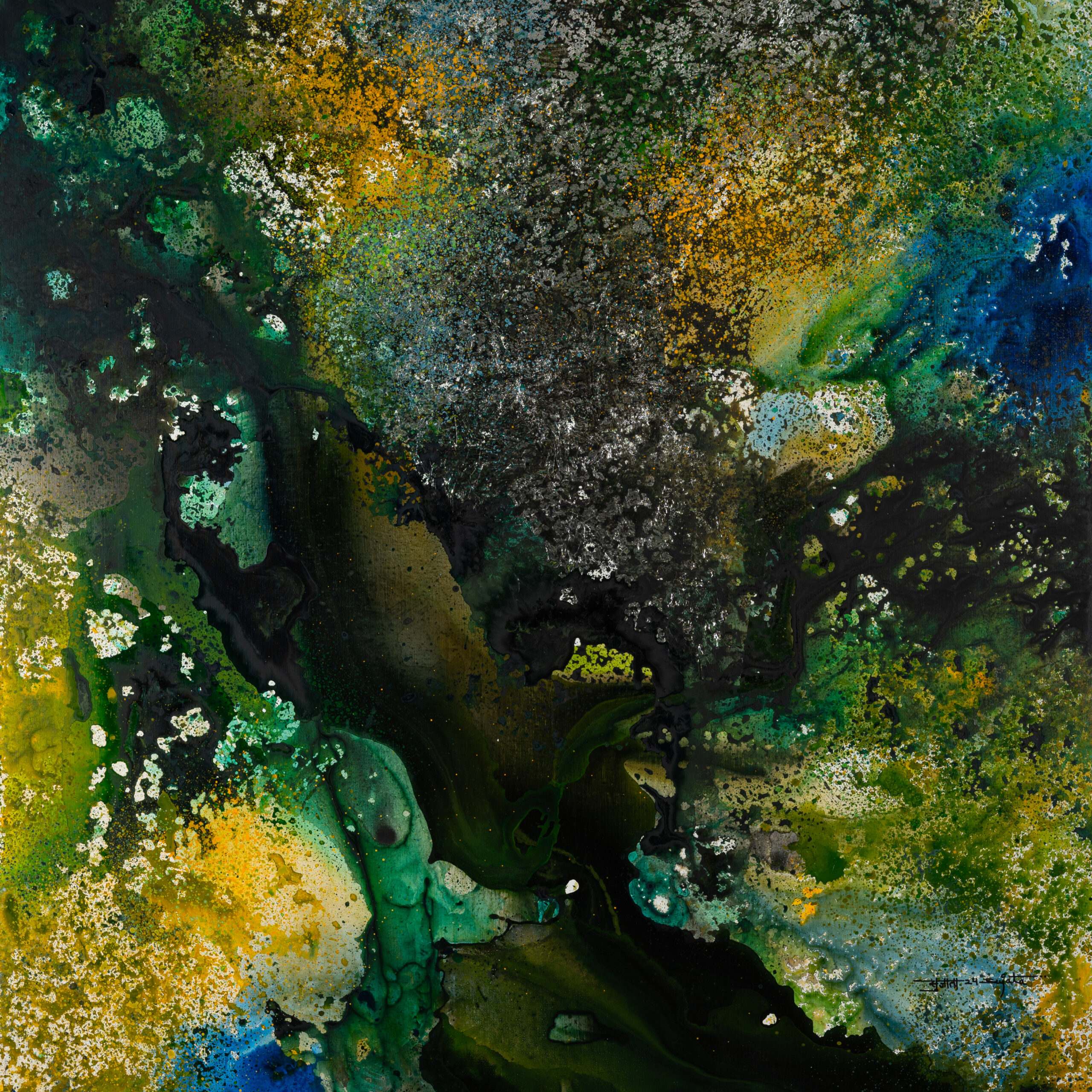
Spacescapes, Magna Stellar Alchemy.
As one slowly soaks in the blooming visions of deep universe spread evenly across the gallery, one can sense the enormity of the galaxy quietly enveloping one’s being. A little more focus is enough to make one realise the position of human beings in the sprawling, endless mass of floating gas and other particles that make up our universe. And several philosophical truisms seem to come alive, which Bajaj sums up best, when she says: “The rediscovery of the cosmos through my paintings has reaffirmed my understanding that in the infinity of deep space, abstraction and reality are one.”
Sujata Bajaj, Spacescapes, January 30, 2026 – February 14, 2026, Gallery Romain Rolland, Alliance Française de Delhi.