

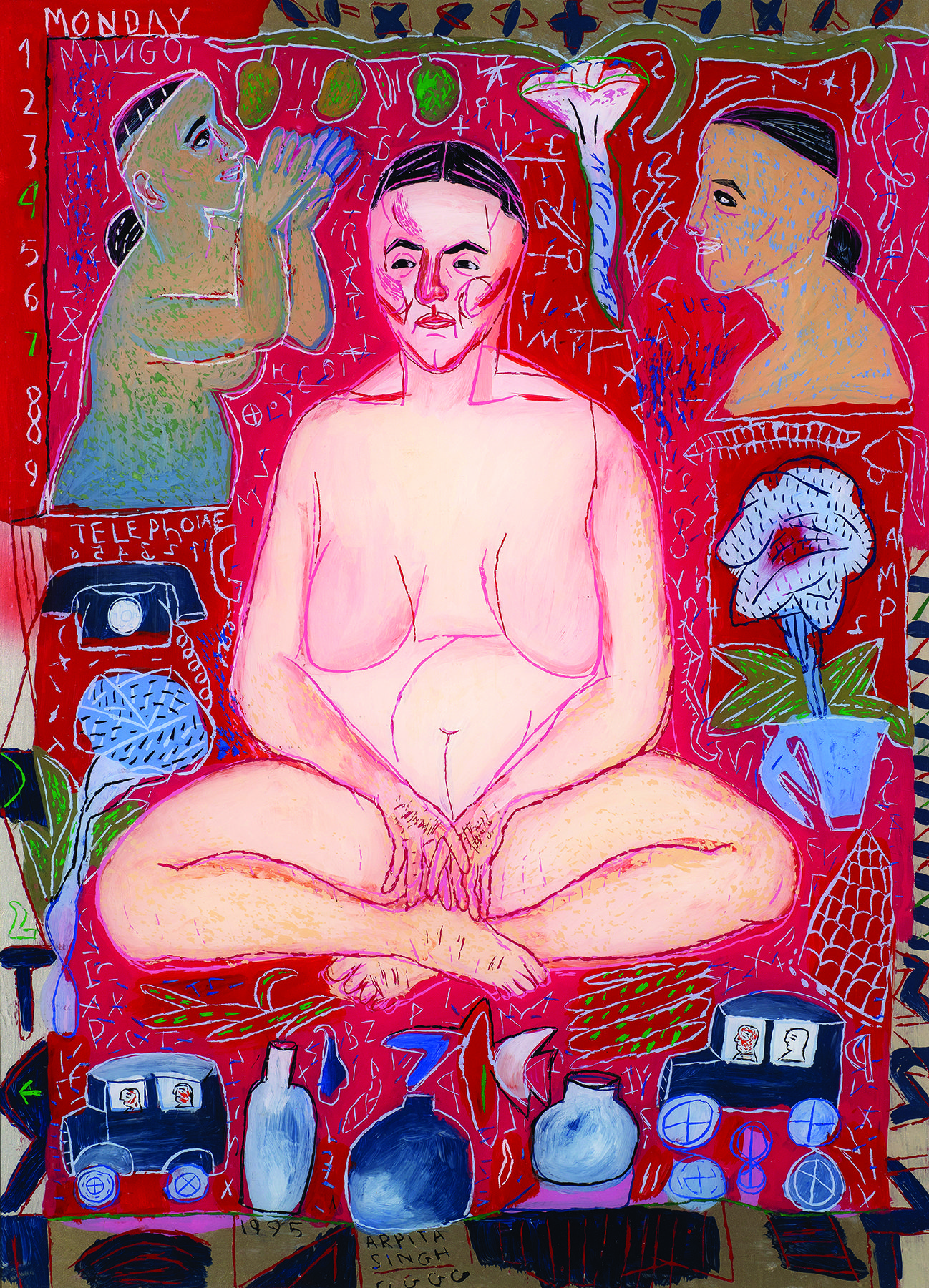
Arpita Singh, A Feminine Tale, 1995. Copyright: Arpita-Singh, Image Credit: Justin Piperge.
A distinctly chalky pink predominates Arpita Singh’s canvases. Sometimes it appears in wreaths of flowers blooming in unbeckoned corners of the canvas, or in candy-floss-like clouds dotted over a bustling Delhi. Elsewhere, it stains a map of Kashmir, afloat seemingly on an island of paper collage, whereas on most occasions, it makes for parts of a theatrical backdrop for Singh’s heroines, each of whom appears as though caught midway in an intense scene unfolding from a postcolonial Hindi memoir. Curated by Tamsin Hong and Liz Stumpf, ‘Remembering’ at the Serpentine Gallery North in London, brings together key works from Singh’s long-standing career of six decades that give an insight into her experimentation with various techniques, influences, themes, and events.
The works in the exhibition are loosely arranged chronologically, with the larger oil-on-canvas works being displayed along the outer gallery walls, while the more intimate works on paper, including watercolours, etchings, and prints, are clustered together inside the two barrel-vaulted brick halls. Early paintings such as Journey (1971), and Figures and Flowers (1972) depict ventures into surrealism that have often been cited as influences of artist Marc Chagall on Singh’s practice. Differently, the ink and watercolour works made between 1974 and 1982 mark a return to the fundamentals of drawing. In works like Untitled (1974), and Untitled (1976), for instance, a recurring series of sharp strokes and bristling hyphal lines conjure up a tightly enmeshed surface that resembles the warp and weft of a handwoven cloth. This would be true for immediately after her graduation in 1959 from the Delhi Polytechnic, Singh took up work at the Weavers’ Service Centre in New Delhi. It was perhaps these early influences from modernists like Marc Chagall and Paul Klee, and textile and folk art traditions of India like kantha (running-stitch) embroidery, and pattachitra scroll paintings that take more prominent forms in her works since the 1980s- signalling a return to figuration, arguably also her most popular phase of painting.
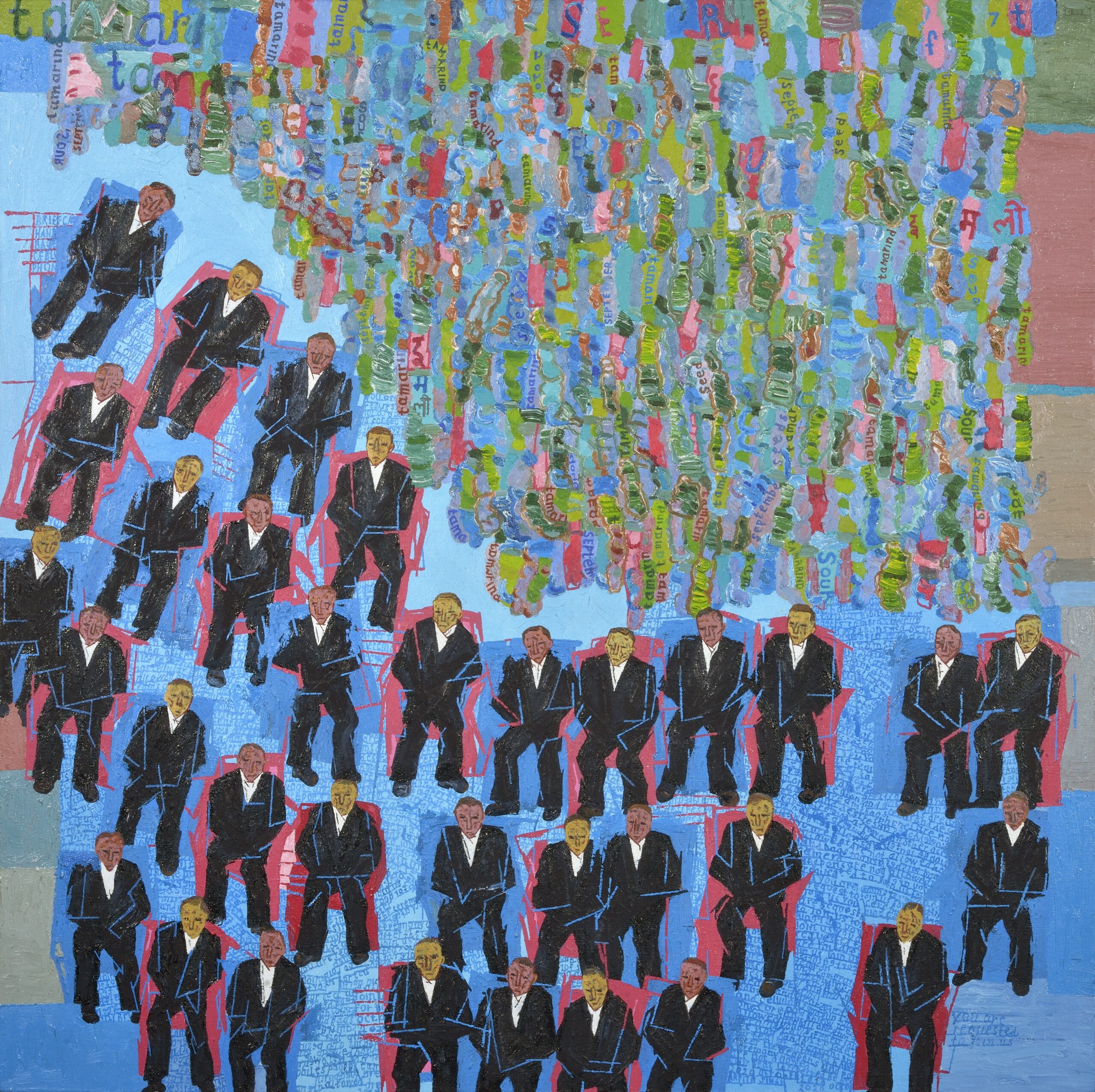
Arpita Singh, The Tamarind Tree, 2022, Courtesy: Vadehra Family Collection. Copyright: Arpita-Singh.
The selection from this period includes some of Singh’s most widely exhibited works including Munna Apa’s Garden (1989), the feminist classic Devi Pistol Wali (1990), My Mother (1993), and the artist’s self-portrait in Untitled (1990) bordered by her hallmark motifs — turtles, mangoes, flowers, and teacups — floating against a lush ocean-blue backdrop.
My Lollipop City: Gemini Rising (2005) — another one of Singh’s monumental pieces — perhaps best manifests her approach towards maps in her practice. Hemmed by the river Yamuna that skirts along a map of Delhi only to dissolve into the horizon, the painting is replete with iconic historical landmarks and a webwork of venous roads, figures, taxis, and texts that string together an especially cacophonous portrait of the city. An enlarged couple, perhaps a reference to the titular sun-sign gemini — an element that Singh developed early on in the 90s — hovers atop this buzz. I am reminded of two later prints made during her time in London: This Could be Us, You, or Anybody Else (2007), and I Could See London through the Clouds (2007); both depicting how intimately the public and the private remain tied for her. In a way, it is through titles and allusions such as these that Singh breaks the fourth wall between herself and her audiences. One realises that this is not a map after all, but an enduring impression of a city on the artist’s mind. It does read in a corner- ‘THIS MAP IS FAULTY, DO NOT FOLLOW IT’.
References are also drawn from Mughal miniatures, as in the case of Noor Jehan (2001), and Hindu mythologies like the Ramayana in Golden Deer (2004), and the Mahabharata in Whatever is Here… (2006), where a Dhritarashtra-like figure sits eyes shut in deep sombreness as he is engulfed by the visual clangour of warfare around him. Having lived through some of India’s most turbulent political episodes, it is but natural that Singh’s sensibilities remained attuned to humanitarian crises not just in her home, but around the world, including countries like Cuba, Palestine, Afghanistan, Poland and Syria.
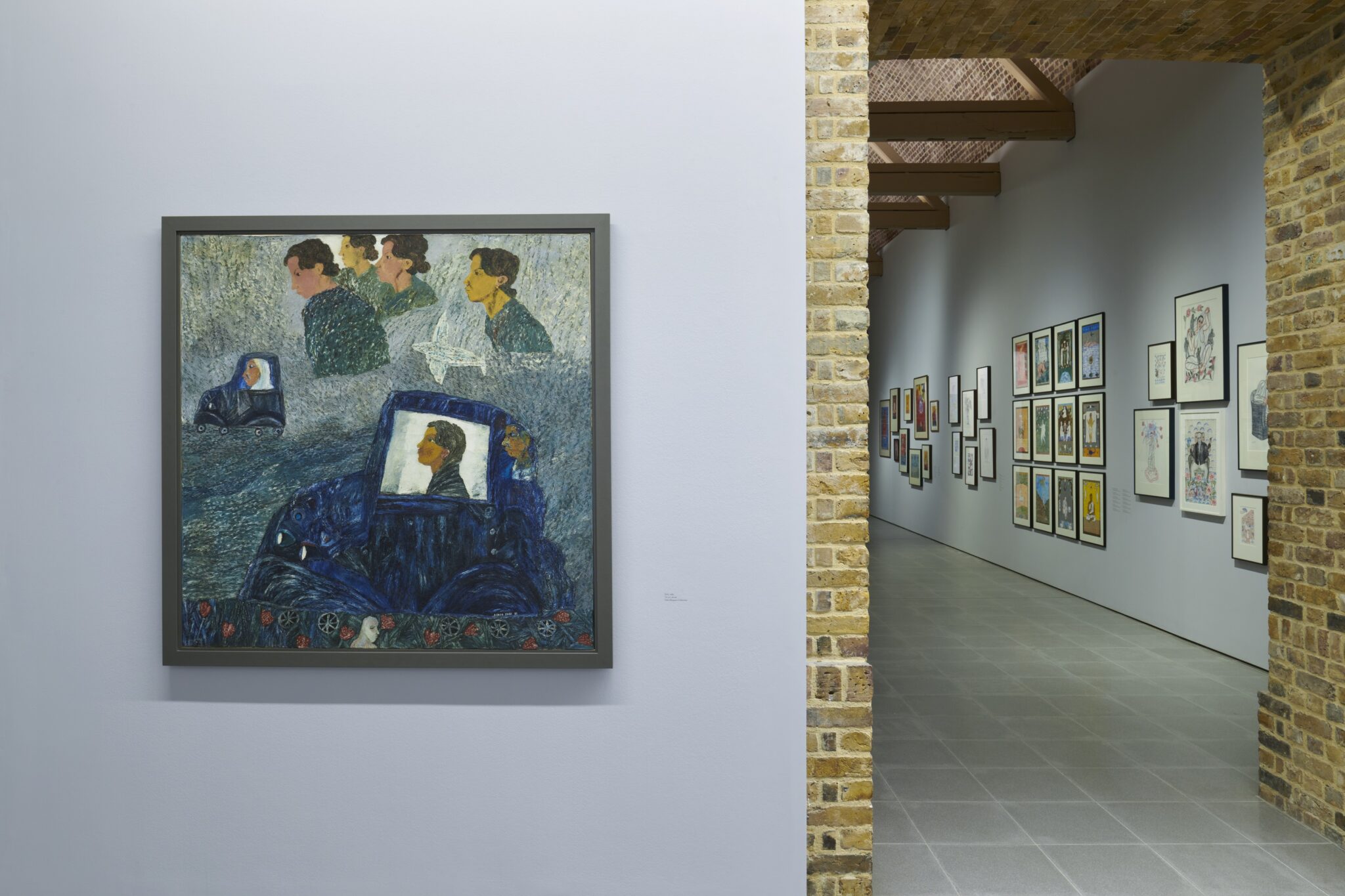
Nevertheless, it is her disarmingly blunt portrayal of the ageing female body — rounded bellies, protruding ribs, sagging breasts, and stern faces with creasing frowns — that depicts womanhood which is at once formidable, sensuous, and vulnerable. These women make up for Singh’s signature aesthetics — fusing together the epic with the quotidian, the domestic with the divine — as she manipulates space, forms, and perspectives towards exceptionally affective and psychological compositions. Works from the last two decades are especially compounded by the incorporation of texts as they slowly start to take on a more abstract, paper collage-like quality in works like the monumental Searching Sita through Torn Papers, Paper Strips and Labels (2015). Indeed, there is always a lot to see and unpack in Singh’s works as characters, narratives, and incidents appear indiscriminately piled together, yet simultaneously parcellised on a plane, evading all attempts at a linear retelling or analogy. All this while, Singh leaves it to her audiences to interpret the meaning behind the paintings for themselves.
Remembering provides for a relatively accessible viewing-experience for a public unfamiliar with Singh’s oeuvre, or South Asian art history at large. Differently, an accompanying booklet guide in place of conventional wall-based interpretation allows for a more detailed reading of selected works. This is in addition to the exhibition catalogue, which includes contributions by art-historian Devika Singh, artist Nilima Sheikh, art-critic Geeta Kapur, and writer Geetanjali Shree. The year 2025 has been noteworthy for South Asian arts — especially women artists — in the UK. Earlier this year, the Barbican concluded with the much-lauded exhibition ‘The Imaginary Institution of India: Art 1975–1998’ curated by Shanay Jhaveri. The Royal Academy in October 2025 is set to open with an exhibition dedicated to artist Mrinalini Mukherjee, and a network of artists around her who were instrumental in shaping the Indian Modern art canon. While it remains true that institutional representation for South Asian arts — especially at this scale — has been long overdue in the West, one cannot help but ask: What happens when representation fatigue sets in? Are we willing to invest in sustainable (infra)structures that go beyond mere diasporic visibility in the long-run? If yes, what is to be the future of this moment in Art History?
Arpita Singh: Remembering, Serpentine Gallery North, London, 20 March – 27 July 2025.