

The exhibition AUTOPOIESIS: A Song for Resuscitation, organized by Shaunak Mahbubani at Arthshila, Goa, is the latest node in a constellation of gatherings that began in 2022. Conceived in Berlin as an intimate sharing session, it has since travelled to Mexico City, Guatemala City and New Delhi, unfolding through exhibitions, talks, poetry and further sessions that brought artists and communities into sustained encounter. This iteration continues her practice not as a singular melting point but as a dispersed methodology linking lived experience and artistic research across the Global South. What emerges is a curatorial logic of nomadic fluidity in which auto-narration becomes the connective tissue between artists, archives and geographies.
Autopoiesis examines the political force of self-narration in the present, when history is consolidated by the agendas of the nation-state and intensified by authoritarian politics and neoliberal extraction. In invoking Sylvia Wynter, Mahbubani draws on Wynter’s critique of modernity’s overrepresentation of Western Man as universal. Raised in colonial Jamaica under British rule, Wynter in Unsettling the Coloniality of Being/Power/Truth/Freedom: Towards the Human, After Man, Its Overrepresentation — An Argument (Manifesto, 2007), challenges this genre through autopoiesis, understood as self-making: the capacity to counter inherited historical violence by re-authoring origin stories. For Mahbubani, resuscitation exceeds restoration: it opens onto speculation and the making of new genres of being. Self-narration is not simply confessional but a practice of inscribing onto the historical timeline.
By bringing together artistic voices running alongside the coastal routes of Kerala, Goa, Karachi, the Malay peninsula and Sri Lanka, Mahbubani identifies what she calls “adjacent topologies,” affinities that emerge through ancestral memory, song, labour, ritual and language rather than imperial cartography. This is crucial in the South Asian context, where movement across the Indian Ocean has been shaped by indentured labour, maritime trade, sectarian conversion, caste-induced mobility and forced displacement. These histories continue to structure the region’s political climate, persisting as unresolved inheritances and afterlives of empire within fractured archives.
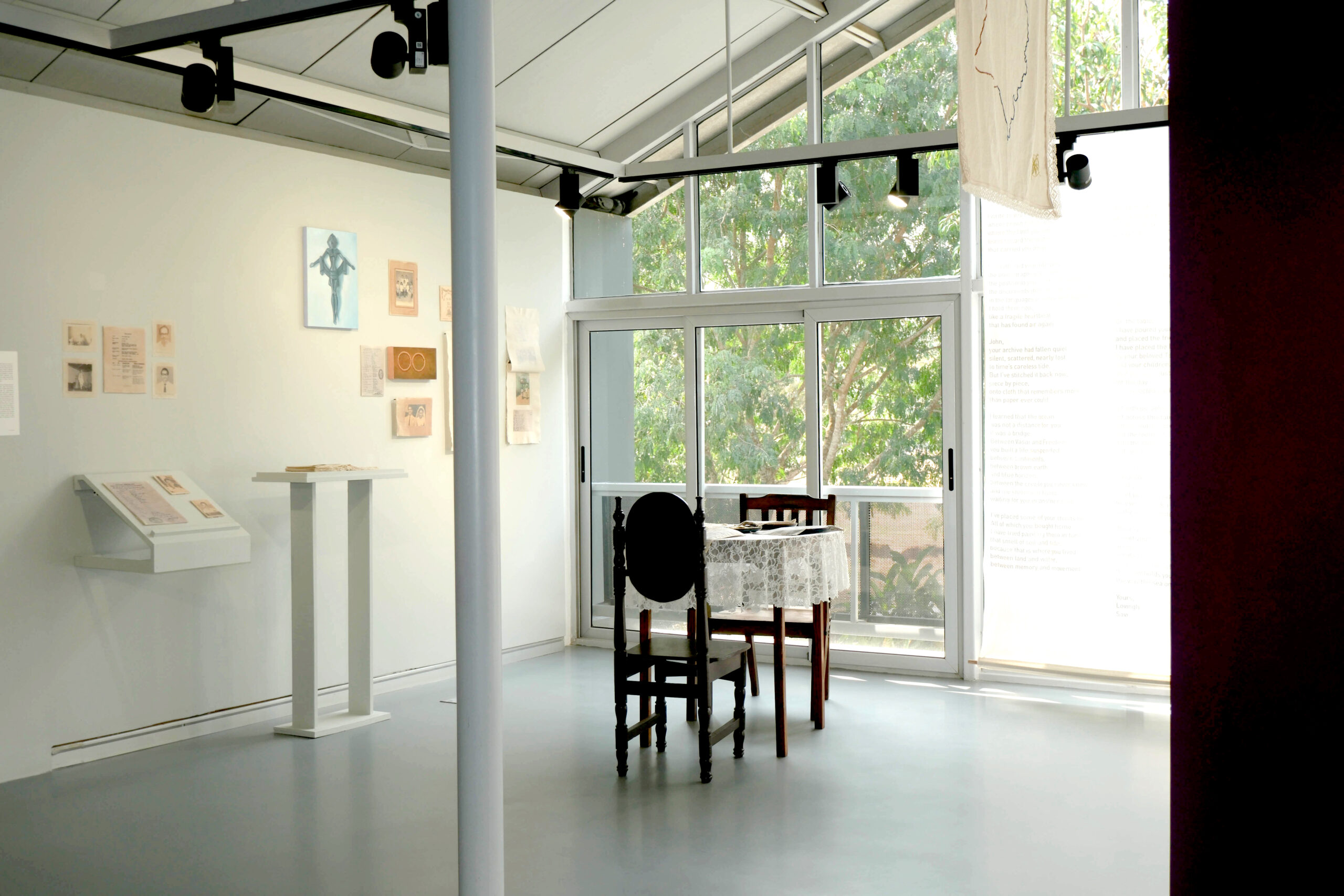
Saviya Lopes, Where Brown Meets Blue, 2016–ongoing. Mixed-media installation. Image courtesy of Shaunak Mahbubani and Arthshila Goa. Photo by Urna Sinha.
These coastal adjacencies are not abstract cartographies but lived routes that surface as intimate archives within the works. Archiving her grandfather’s journey from Vasai to Freetown, Saviya Lopes translates passports, letters and photographs into textiles. His migration unfolded within British colonial labour circuits linking western India to West African port cities. In a domestic interior anchored by a lace-covered table, state records soften into cloth. Above, a stitched outline connecting Vasai and Freetown suspends lightly, nations picked apart and rejoined by thread. The archive shifts from administrative proof to tactile inheritance.
If Lopes traces documents that travelled, Karachi-based Jovita Alvares turns to what migration leaves behind. Drawing on a sparse family archive tracing Goan Catholic migration to Pakistan, she animates photographs through light boxes and video, activating what colonial and post-Partition records left fragmentary. Shaped by Portuguese colonization of Goa and later Partition politics, her work dwells in unbelonging, where family photographs and oral recollections function as fragile custodians of history, preserving what state records and colonial documentation have failed to hold.
Priyageetha Dia turns to the history of rubber plantations in British Malaya, where Tamil labourers were transported under the British Raj. The plantation functioned as a site of extraction, discipline and caste-inflected hierarchy, yet it was also where displaced communities forged continuity. In her immersive CGI video LAMENT H.E.A.T, centered on oppari, a Tamil Dalit lamentation practice, Dia reconstructs the plantation as a dialectical terrain. The archive here emerges as what Homi Bhabha in The Location of Culture (1994) describes as a “third space,” neither solely wound nor refuge, but a contested site where meaning is negotiated.
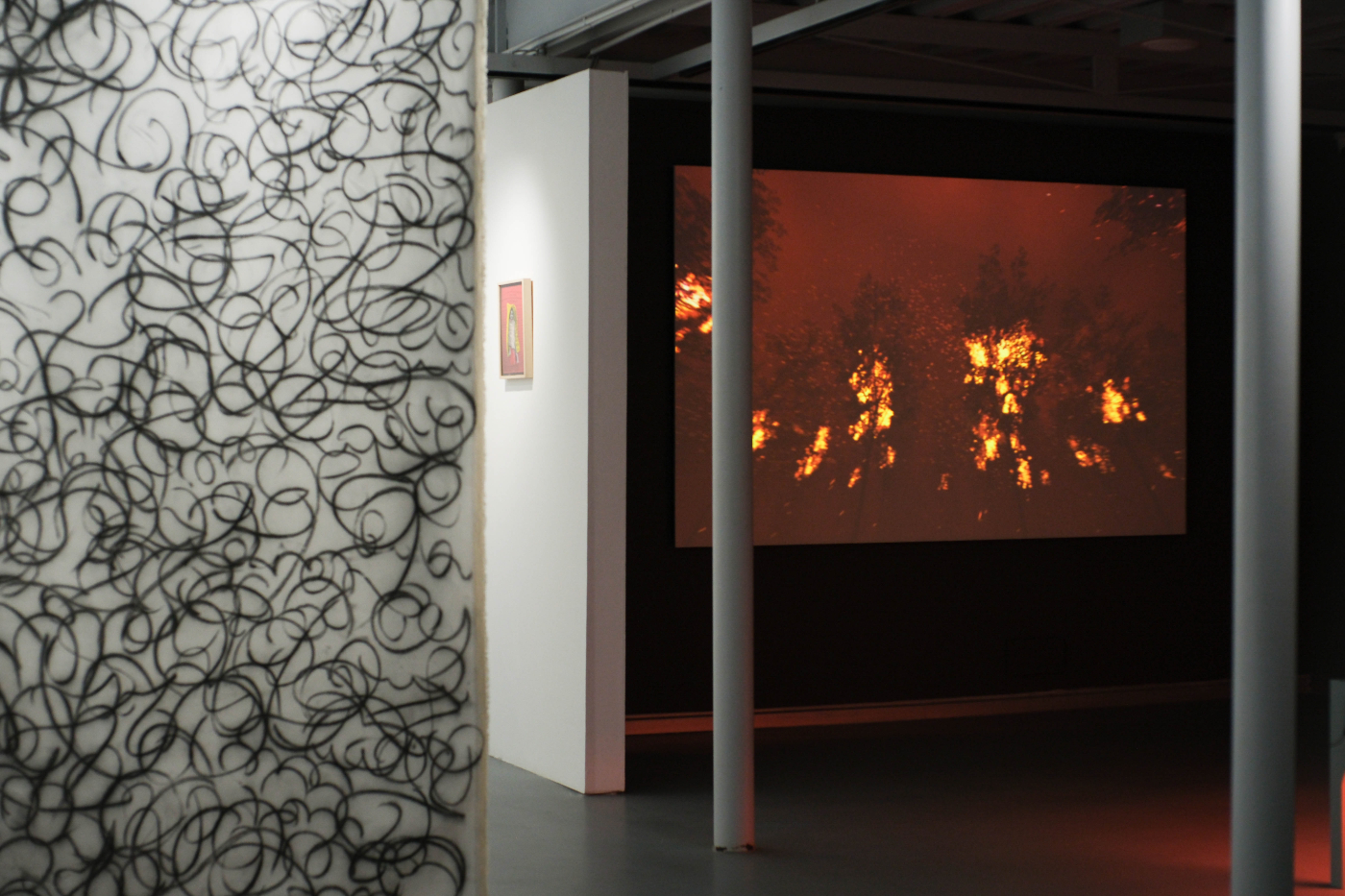
Sajan Mani, MalayaShareeram, 2022, charcoal on canvas; Priyageetha Dia, LAMENT H.E.A.T, 2023, video installation. Image courtesy of Shaunak Mahbubani and Arthshila Goa. Photo by Urna Sinha.
In Who Will Sing These Songs?, Colombo-based multidisciplinary artist and curator Imaad Majeed transforms the gallery into a communal gathering space. Audiences rest on circular woven mats, listening to archival audio drawn from Sri Lankan Muslim women’s folk traditions. Invoking kummi adi, a circle sustained through clapping and shared breath, time is measured collectively. Migration circulates through rhythm. Song becomes a living counter-archive binding memory across sea routes that produced creole kinships.
The exhibition stages a structural intervention within a region long shaped by layered violences and oceanic crossings, treating the body as a relational field. Mahbubani, whose great-grandparents were forced to migrate from Sindh following Partition, places her own body within this terrain. Her video Rituals for a Displaced Land-Body, positioned as a curatorial footnote, renders self-making as lived practice, her body functioning as an intergenerational vessel. In foregrounding her displacement, she shifts the traditional notion of the curator. By reframing herself as organizer, she diffuses curatorial authority while holding space for vulnerability to circulate. The stakes of auto-narration return to her own body. The curator becomes an implicated presence rather than an external mediator.
Sajan Mani’s long scrolls hang from the ceiling, inscribed with the protest poetry of Kerala’s Dalit reformer Poykayil Appachan. The work becomes an archive of the artist’s movement, where layered Malayalam script loops across fabric. While the text is illegible, its opacity accumulates across the white surface as embodied memory. Language becomes labour, repetitive and gestural, like breath carried through the body. In a similar vein, Jahangir Jani’s practice proposes that the body carries its own archive. The canvas becomes skin, marked, layered and scarred, encoding memories of past lovers and functioning as a site of desire. Memory settles onto the surface, where intimacy sediments into symbolism.
Movement through the two floors of the gallery becomes part of the exhibition’s rhythm, where spatial arrangement extends Mahbubani’s curatorial logic. Artists are placed in quiet pairings that allow their practices to speak to one another. On the ground floor, Sajan Mani’s inscribed surfaces converse with Jahangir Jani’s textured paintings, while Priyageetha Dia’s plantation landscapes unfold alongside Jovita Alvares’ fragile photographic archives. Upstairs, Saviya Lopes’ textile-based migration archive sits in dialogue with Imaad Majeed’s sonic installation, where spatial and historical proximities emerge through memory rather than state borders.
In I Do, Do I? Goa-based Avril Stormy Unger extends this logic through performance in the outdoor amphitheater. Wearing a bridal gown carried across previous performances, she kneels and begins to nail the fabric to the wooden podium. Each strike fixes the dress more tightly, staging marriage as institution and enclosure. As she works herself free, loosening the fabric and reclaiming her voice, the performance shifts from containment to liberation. Avril’s body pulling against the nailed fabric becomes allegory for the exhibition itself. It is this act of undoing that auto-narration offers to South Asian artists who refuse inherited roles and the simplifying frames through which colonial and postcolonial institutions have classified them.
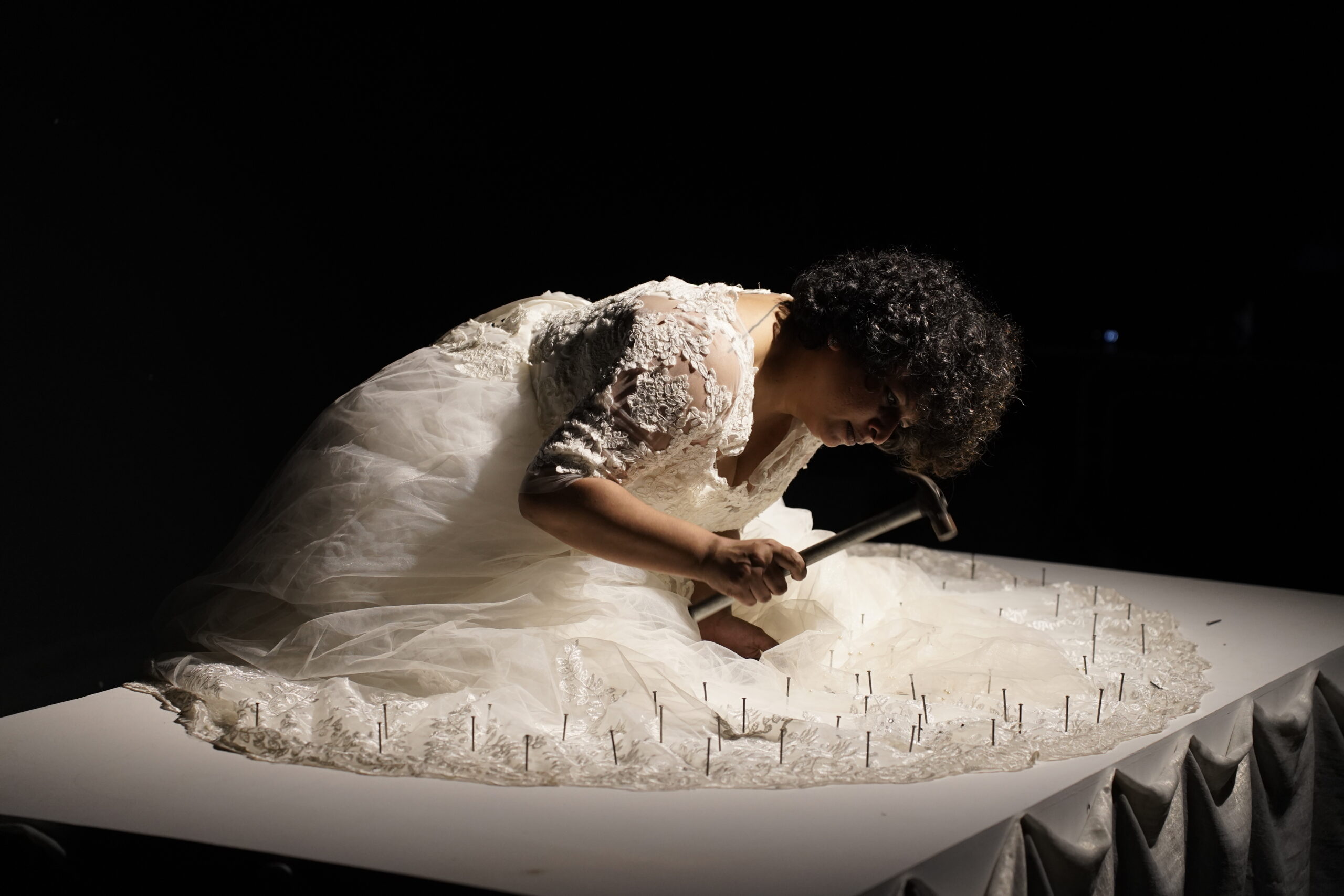
Avril Stormy Unger, I Do, Do I?, performance, 2025. Courtesy of Shaunak Mahbubani and Arthshila, Goa. Photo by Chaitali Paranjpe.
AUTOPOIESIS does not simply answer Gayatri Chakravorty Spivak’s question, Can the Subaltern Speak? (1988). It instead examines what shifts when those historically rendered inaudible within colonial and postcolonial regimes of representation begin to inscribe and perform their own histories. It foregrounds the urgency of self-narration at a moment when authoritarian politics and neoliberal economies continue to consolidate history into singular narratives. What emerges is not mere visibility but structural reordering. When the historically marginalized authors their own genealogies, they do not simply insert stories into existing frameworks; they alter the frameworks themselves. In doing so, they generate new epistemic orders in which archives breathe, bodies inscribe and history becomes plural, negotiated and alive.
AUTOPOIESIS: A Song for Resuscitation, organized by Shaunak Mahbubani, 6 December 2025 – 1 March 2026, Arthshila, Goa.