

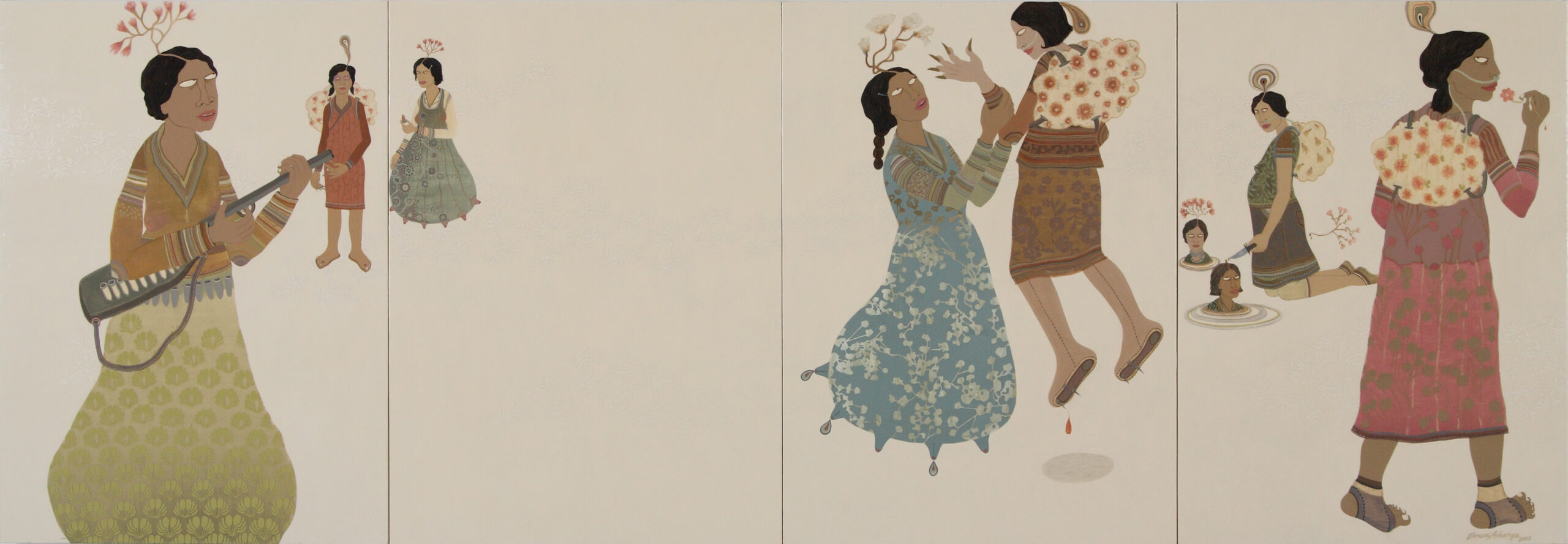
 Air Fare (2008), Synthetic polymer paint on canvas.
In a sea of beige, grey droplets appear. Ripples of black, white, and milky brown circle within. On one end of the spectrum, a woman leans on a stacked table, paintbrush in hand. At her horizon lies a daunting canvas. This work, titled Paint (2004), is a defining example of Dhruvi Acharya’s practice. The viewer is drawn into Acharya’s world through her compositions. Your eyes wander through the ripples and shifting forms as they move around the figures that anchor and carry her message. At times, words emerge, fragments of conversations that seem to belong to another time, borrowed from the Indian comic Amar Chitra Katha, are placed playfully beside her figures.
Acharya’s women are neither confrontational nor shy. They greet you with a calm urgency, meeting your gaze and luring you in. Across two decades of painting, Acharya’s journey has unfolded alongside these figures. They grew to become something more, and she became with them. In the beginning, as in Paint, her subjects turned inward, consumed by what lay before them, or by what was rising from within.
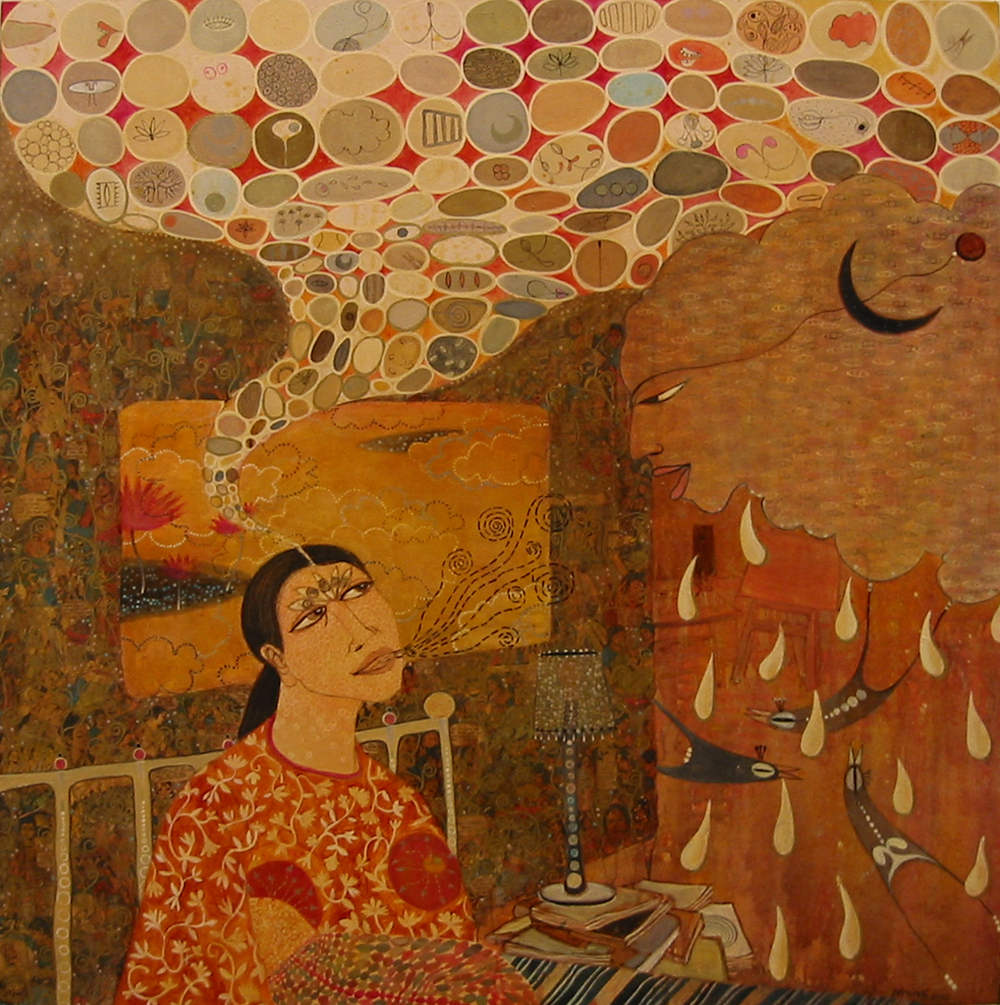 Awakening (2002), Synthetic polymer paint & paper on canvas.
Her practice began in the United States, shaped by homesickness. Drawing became a way to remain connected to what she knew and to what she was yet to discover. She began with small gestures by painting on greeting cards. After graduating from the LeRoy E. Hoffberger School of Painting at the Maryland Institute College of Art in 1998, she moved to New York City with her husband, who was studying film. There she stood at the threshold of her evolution as an artist, being one of the few Mumbai-born painters working at the turn of the millennium in the metropolis. The distance from home gave her clarity—a vantage point from which to see her life and society in India with a renewed perspective. This shift coincided with the rise of galleries in Chelsea, where art was beginning to move away from irony and toward emotion between the 1990s and early 2000s. Acharya arrived just as this transition was taking place. She absorbed the remnants of irony and softened them into something more personal—realising that art could hold both gravity and lightness, that it need not always be solemn. Situated in the city, three decades after the feminist art movement, she carried the undercurrents of those ideas in her practice, while reminiscing about the world and societal systems she had left behind.
From navigating the expectations of society to eventually discovering the freedom of a new city, Acharya began to question the unseen rules that governed the lives of women. The sense of liberation she found in New York allowed her to look back at the constraints she had known growing up in India. Her painting Captive (2000), made two years after her move, reflects this questioning. A bright red packet of chips, held by a large woman on a flowery couch, speaks to the pressure women face about their bodies. The image is both humorous and tender, revealing how deeply such expectations run. The artist portrays what many of her friends and relatives experienced: the quiet insistence that a woman must be the “perfect” size to find a husband.
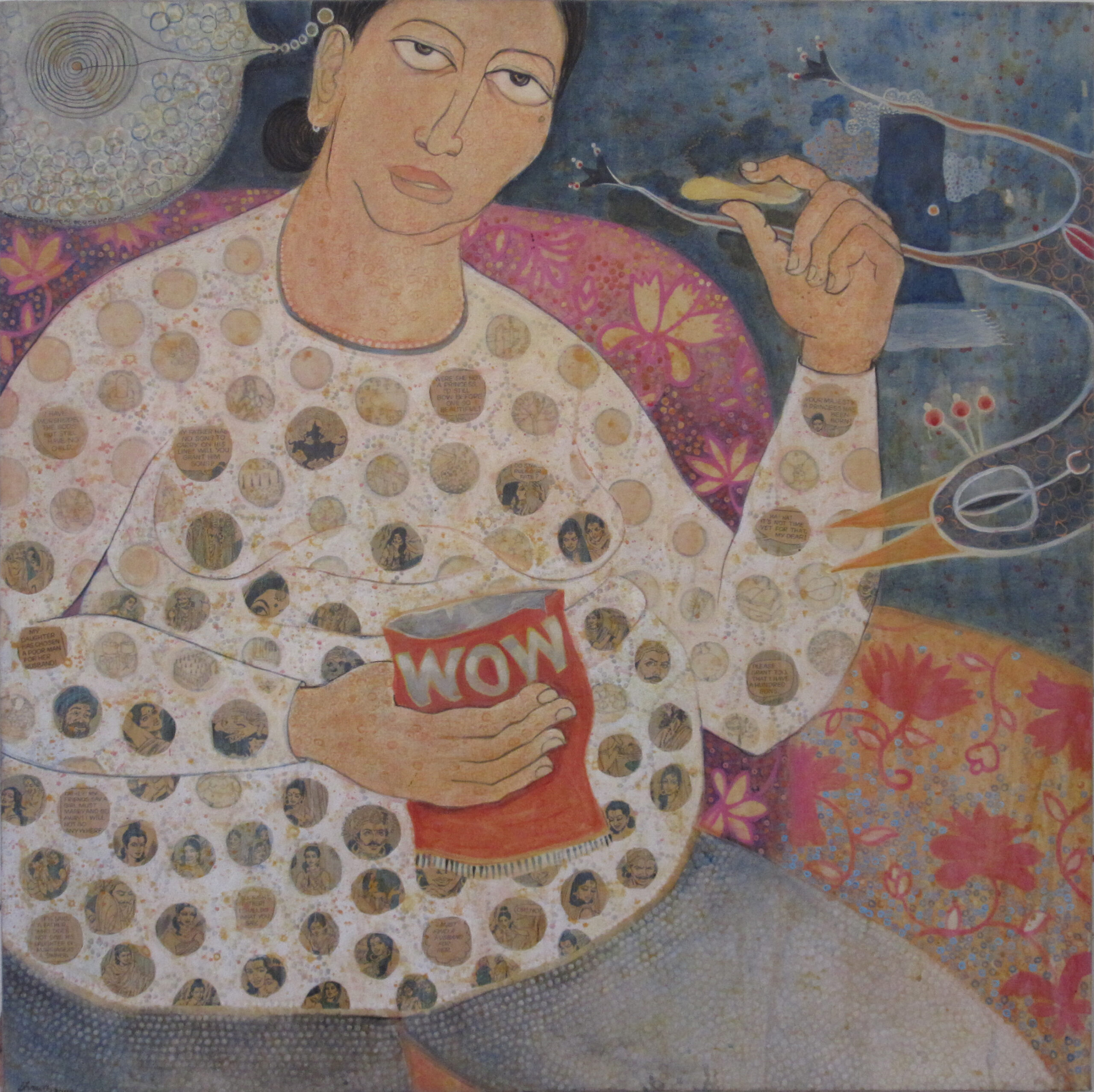 Captive (2000), Synthetic polymer paint & paper on canvas.
For Acharya, the personal and the political are intertwined. She has said that once you are impacted by the wayward shifts in life, you begin to see the world with greater attention. This awareness began to shape her later works. Her painting Airfare (2008) speaks of the declining air quality, after suffering a wheezing fit while training for a marathon. Nine women drift across four vertical panels, their bodies carrying “breath packs” as they move through a barren landscape. One figure appears to be expecting a child. It is one of several paintings that capture the transformation of a woman’s life during motherhood.
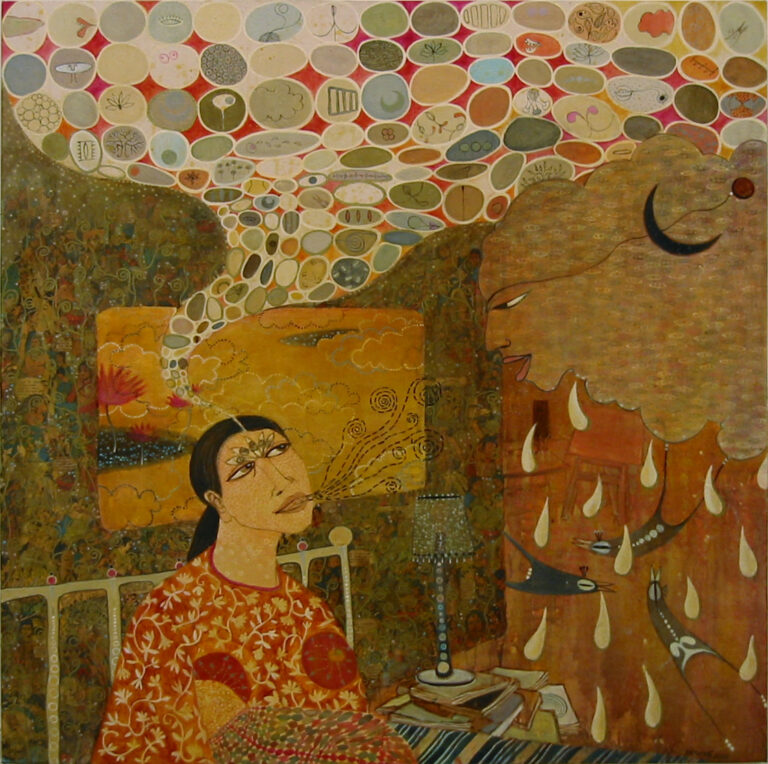
Much like Frida Kahlo, Acharya reveals the inner life and complexity of being a woman. In Awakening (2002), painted while she was expecting her child, a woman rests in bed, leaning against the rails. Her bedside table is busy, her thoughts gently amok, contemplating the many possibilities of her unborn child, while a black crescent moon in the distance witnesses both presence and becoming.
Acharya’s work dwells in the spaces a woman inhabits, tracing the tensions between societal expectation and inner desire, grief, hope, fear and freedom, while probing what it means to inhabit a female body. Though she has braved many storms, her paintings carry a lightness. Glitter often shimmers across their surfaces, a subtle ease to the emotional gravity of her scenes. Across her practice, a woman’s story unfolds in fragments and revelations. To encounter Acharya’s work is to witness this becoming—to follow her through spaces both intimate and distant.
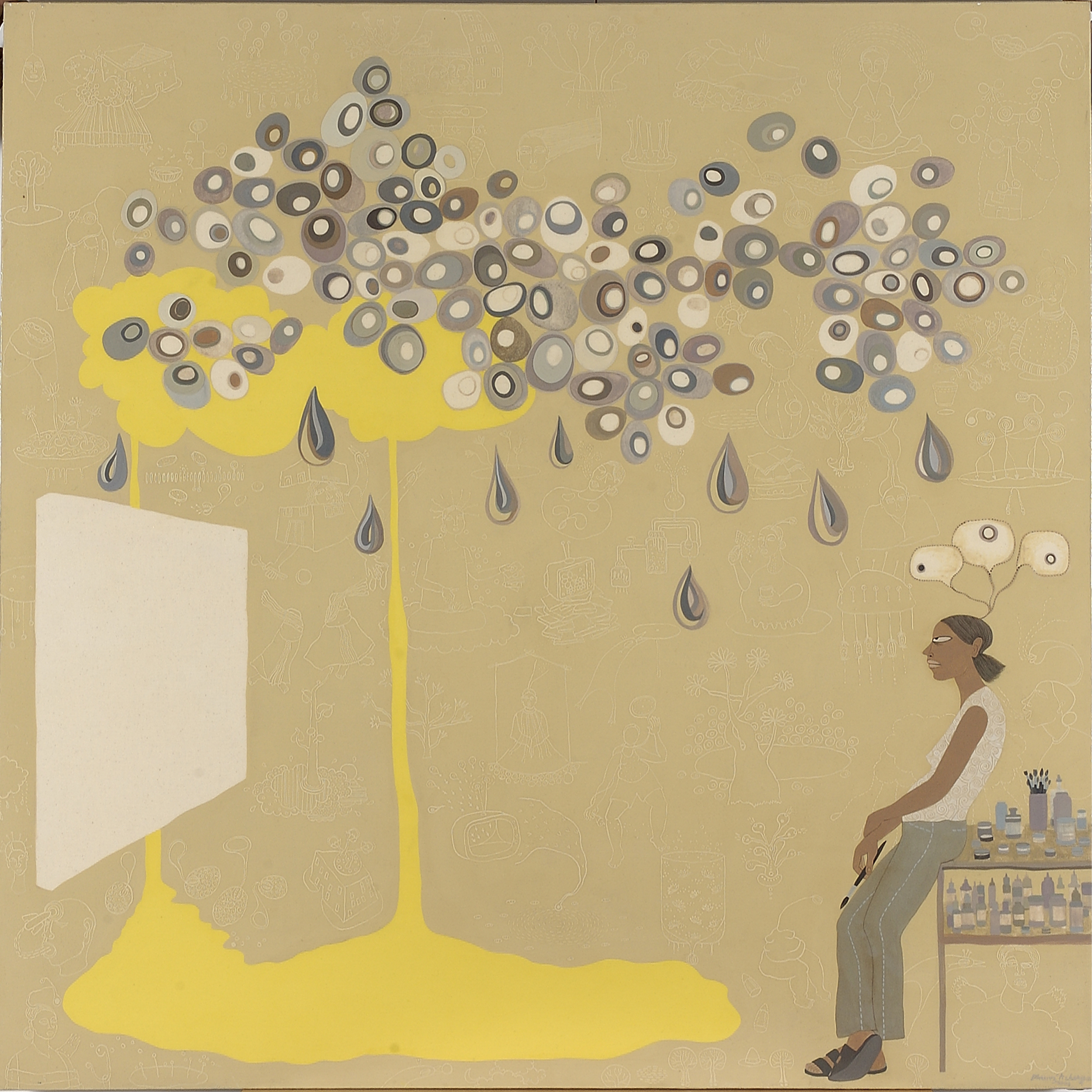 Paint (2004), Synthetic polymer paint on canvas.