

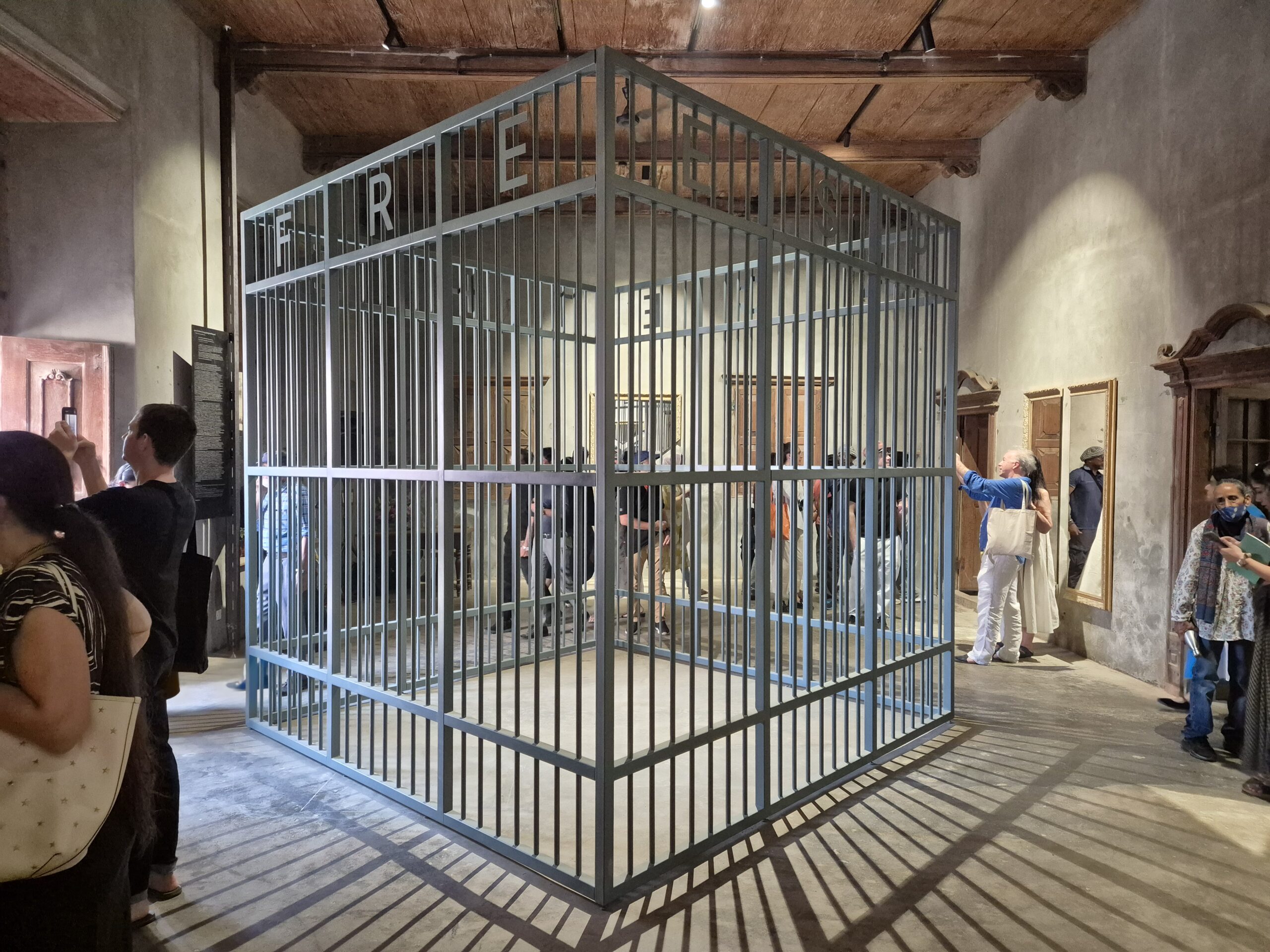
 Michelangelo Pistoletto, Division and Multiplication of the Mirror, 2025. Image Credit: Anuj Daga.
To encounter a larger-than-human metal cage at the centre of a weathered room, encircled by mirrors broken in the middle, held together in wooden frames and each separated by a measured interval along the broad walls of the same space, which does not shy away from speaking of its age: the idea of the human race caught in its hubris to glorify its hyphenated identity is introduced. Subtle enough to stay in the minds of the debutant visitor to the exhibition Amphibian Aesthetics at Ishara House, hitherto Kashi Hallegua House, which is a 200-year-old structure in Mattancherry’s historic Jewish quarter, Kochi. The former work The Free Space and the latter Division and Multiplication of the Mirror, both by Michelangelo Pistoletto, play with scale in relation to space to stimulate the body of the audience, if not overwhelm it. The duality steered by the curator Riyas Komu within the title of the exhibition Amphibian Aesthetics finds its visual counterpart within the arrangement of these two installations.
Not a celebratory idea of nature’s unique benevolence, i.e., the amphibian, but a nudge to the human tribe to recognise and acknowledge the abyss of apocalypses it has entailed in the face of unchecked urban development. The hyphenated identity of an amphibian, which can live on land as well as in water, within the realm of the exhibition, epitomises the catastrophe humans have waged on the Earth, only to break its existence rooted in harmony with nature. To mention, Amphibian Aesthetics marks the first exhibition presented at Ishara House, initiated by the Ishara Art Foundation in Dubai. The exhibition, alongside the Kochi Muziris Biennale, is organised in partnership with Aazhi Archives: a collective of artists, writers, scholars and researchers engaged in collaborative studies of Kerala’s maritime past and its changing artistic cultures.
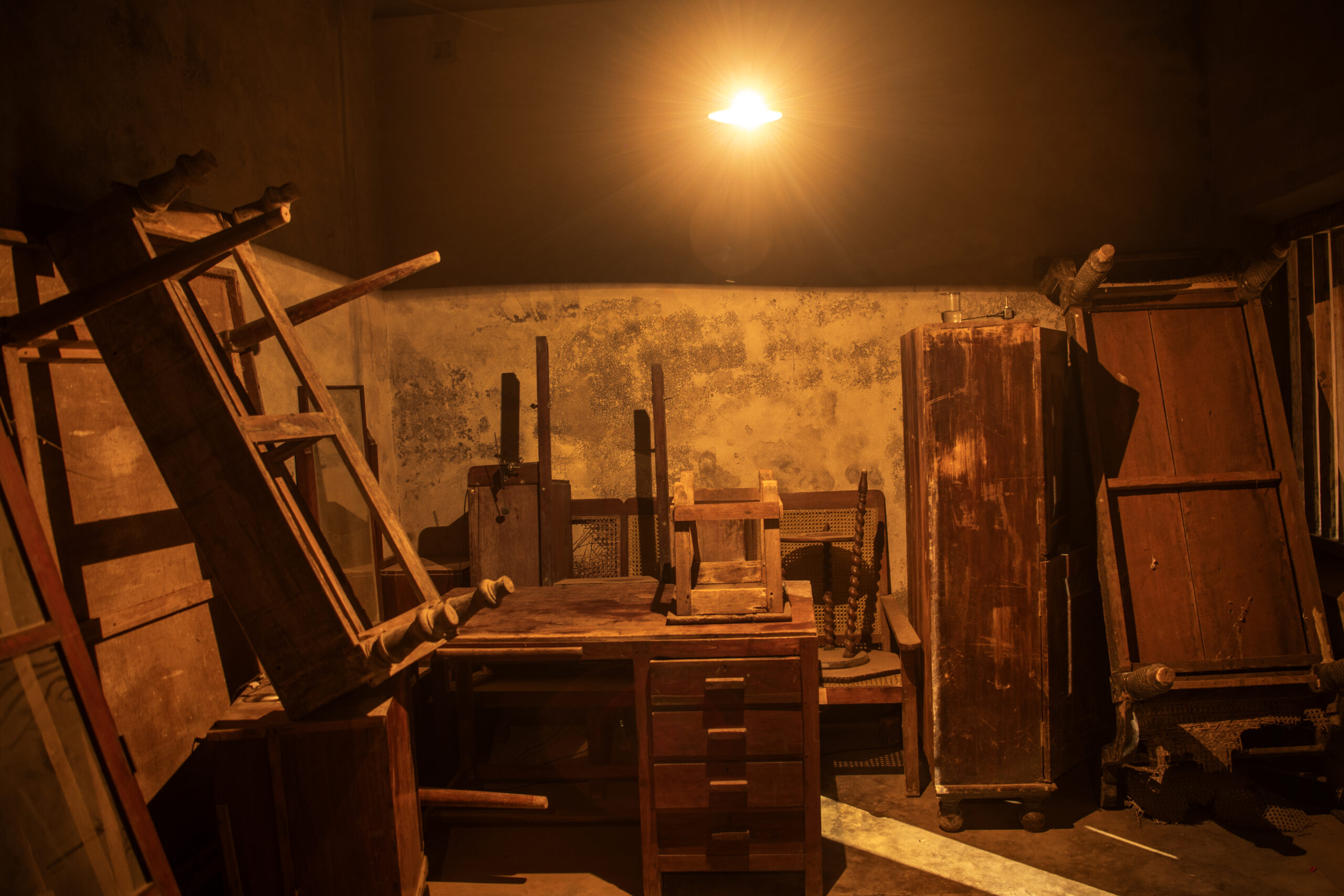 Shilpa Gupta, When the Stone Sang to the Glass, 2025. Image Credit: Biju Ibrahim
The room leads to the next part of the Jewish House, which has a metal installation In, Between in the shape of the hull of a ship, complemented with acoustic sonar by Shanvin Sixtous, proprietor of Vinton Engineering, an architectural metalworks firm based in Kochi. The inherited nature of a hull demands it negotiate across land and water. The scale of the hull stands as a metaphor for the expanse of labour and migration it takes into its stride to meet the insatiable demands of humans. In proximity to the installation is a metal staircase leading towards an installation of archival prints, Man Holding His Dreams by Midhun Mohan, placed on a mezzanine level. A supplement to Sixtous’ idea of circulation, the images by Mohan enter the domain of “satirical counter-narratives” to the hegemonic histories of colonialism and slavery. A lone man holding the weight of a miniature version of a home in his hands against the backdrop of sand dunes, a stranded headless man sitting on a lifeboat in a water body, a paraphernalia of devotional possession, amongst other colourful images, when watched together, evoke a poignant atmosphere of a solitary life endured in the rage of convenience.
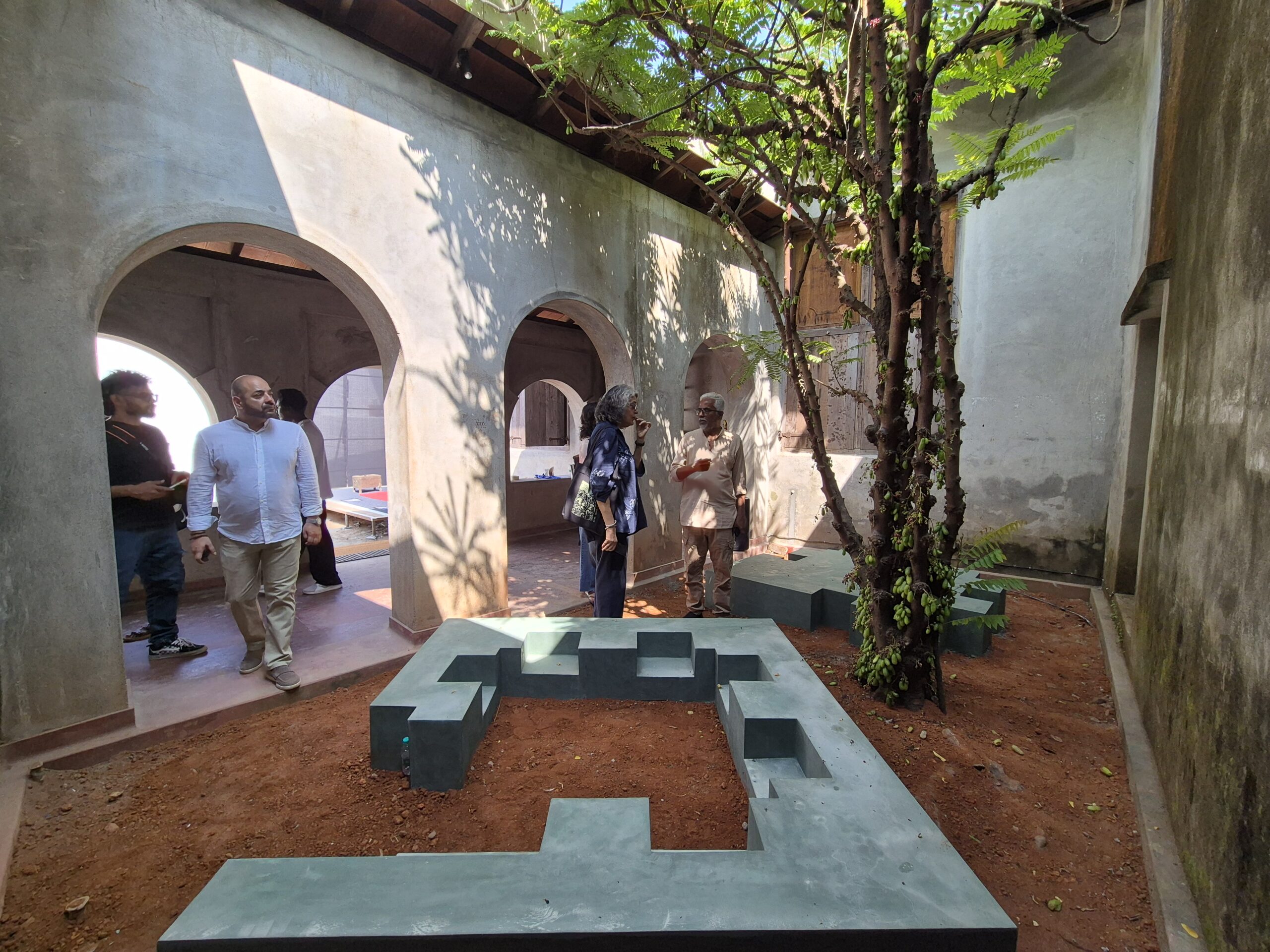 Dima Srouji, Foundations, 2025, Image Credit: Anuj Daga
The reality of extractivism finds resonance with the human proclivity towards global war in Dima Srouji’s site-specific work Foundations. Under swathes of sky, the spatial composition reimagines the floor plan of an Ancient Gazan tomb, which was originally excavated in the 1930s. The elevated structures in the shape of multiple open square boxes encapsulate the artist’s statement, “the land refuses to disappear”. An invitation to traverse the distance between the in-situ installation and the audience, Foundations lets people convene around it to touch and take a seat. In doing so, this act is an extension of bearing solidarity with the ongoing struggle of the Palestinians.
Within the hyphenated identity of an amphibian, the binary of the personal and the political is measured on a lopsided scale within the hierarchy of preferences. The subtle nuances of this are visible in another site-specific installation When the Stone Sang to the Glass by Shilpa Gupta. Upon entering the two small rooms, the visitors encounter an uncanny sense of familiarity: found furniture has been repurposed by Gupta as instruments of resonance, vibrating softly with the echoes of the protest poem Hum Dekhenge by Faiz Ahmed Faiz. Through this reference, Gupta draws a connection to the authoritarian regimes that have historically suppressed the peripheral and continue to perpetuate it through the surveillance of dissent. By holding the familiar and the unfamiliar within the same space, the found object and the protest poem, Gupta stages a powerful juxtaposition of the public and the private.
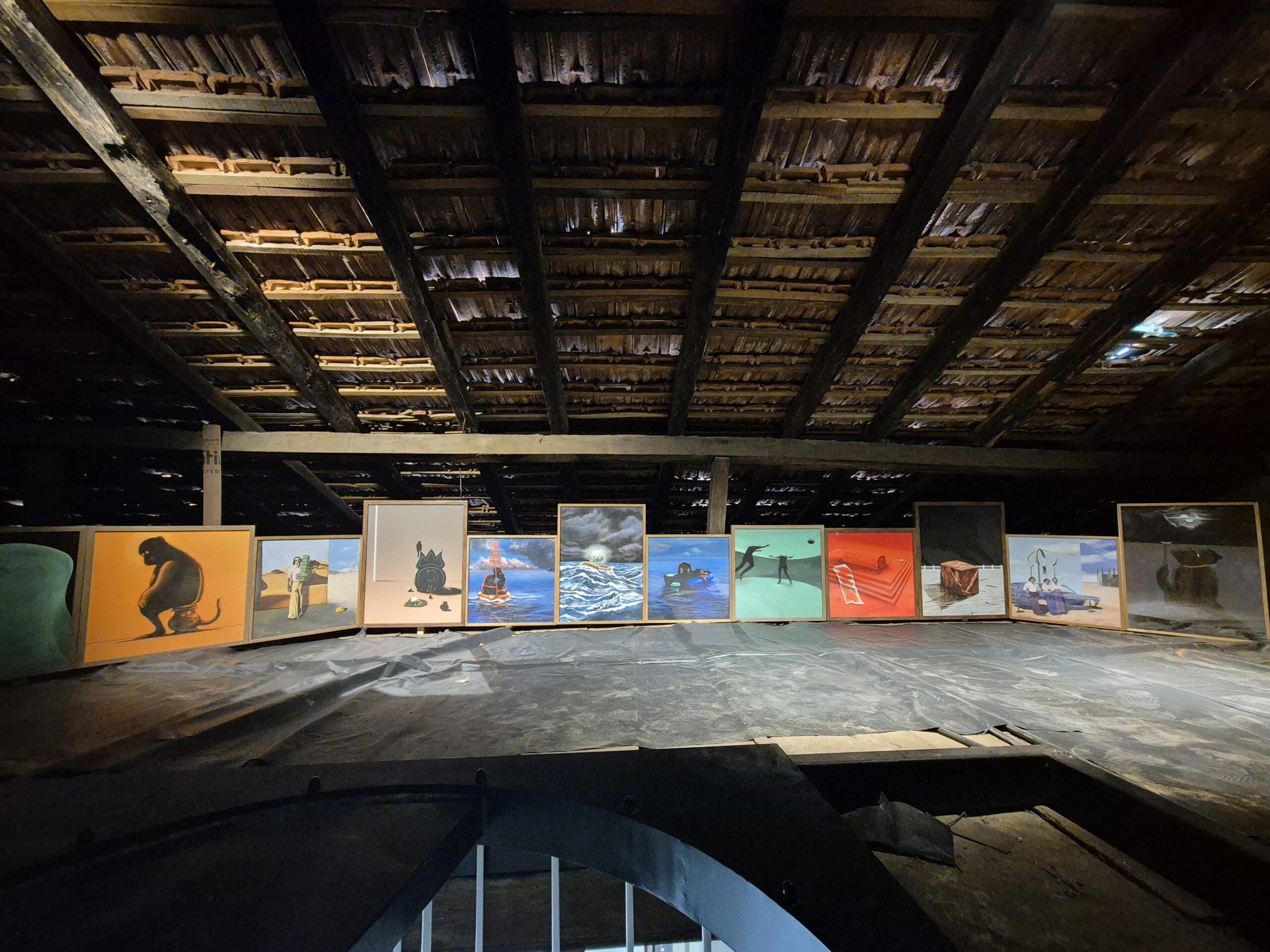 Midhun Mohan, Man Holding His Dreams, 2022, Image Credit: Biju Ibrahim.
Amphibian Aesthetics frames the viewer within an uneasy threshold where reflection obliquely slides into complicity. The metaphor of the amphibian is suspended between ecological awareness and persistent exploitation. While the installations mobilise incisive visual and spatial strategies, mirrors, metal structures, found objects and sonic interventions, the exhibition oscillates between critique and spectacle to invite contemplation across the tension between institutional display and the urgent realities they reference. The spatial orchestration of Amphibian Aesthetics amplifies the contradictions and situates the audience as both witness and participant, not allowing them to escape the systems of power and consumption that withstand the crises the works attempt to critique.
Amphibian Aesthetics, 13 December 2025 – 31 March 2026, Ishara House.
.