

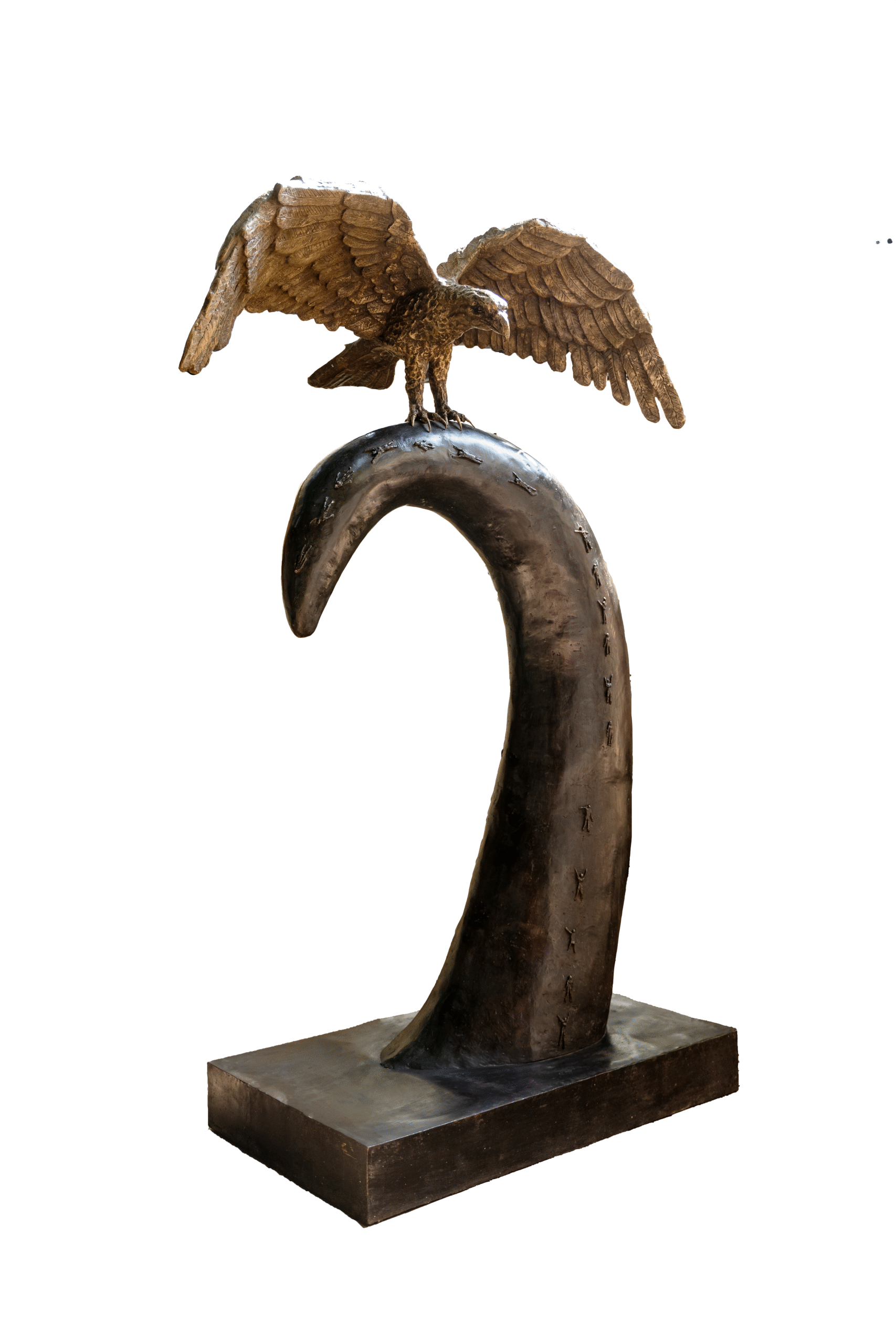
 His Majesty. Image Courtesy: K. R. Nariman.
Travelling through the dense thicket of Kaziranga National Park in Assam in 2019, artist K. R. Nariman was preoccupied with thoughts of nature’s proportions and man’s distortions. She was astounded to see the stump of the horn on the rhinoceros’ head, designed by nature as perhaps the most inconsequential part of this grand animal’s body, become the main attraction for man and consequent cause of its rapid extinction. One of her most iconic bronze sculptures, ‘Precarious’, was born of this train of thought. It depicted a small rhino perched on the edge of a large, curved beam, sitting atop a precipice, poised to fall off any moment.
In the years since, Nariman’s preoccupations with the precarity of the relationship between nature and man, have found form in a variety of mixed media art works. ‘Elemental’, currently on at Bikaner House, Delhi, is the sweeping solo show resulting from this. As she puts it, “It showcases my journey into the sculptural exploration of the interconnectedness between man and nature. I have tried to capture the dualities of both permanence and fluidity in the elements.”
The interconnectedness of life: human, animal and mineral is a recurring theme through Nariman’s works. Most of the 160 pieces on display are fashioned in bronze, a material she has been drawn to ever since beginning her practice in 2013. What’s new, however, are her works marrying bronze sculpture with painted canvas, a technique she took three years to perfect. She also plays with multimedia by projecting films on to her mixed media canvases, in turn imbuing them with life. It isNariman’s attempt at portraying the three-dimensional nature of existence. 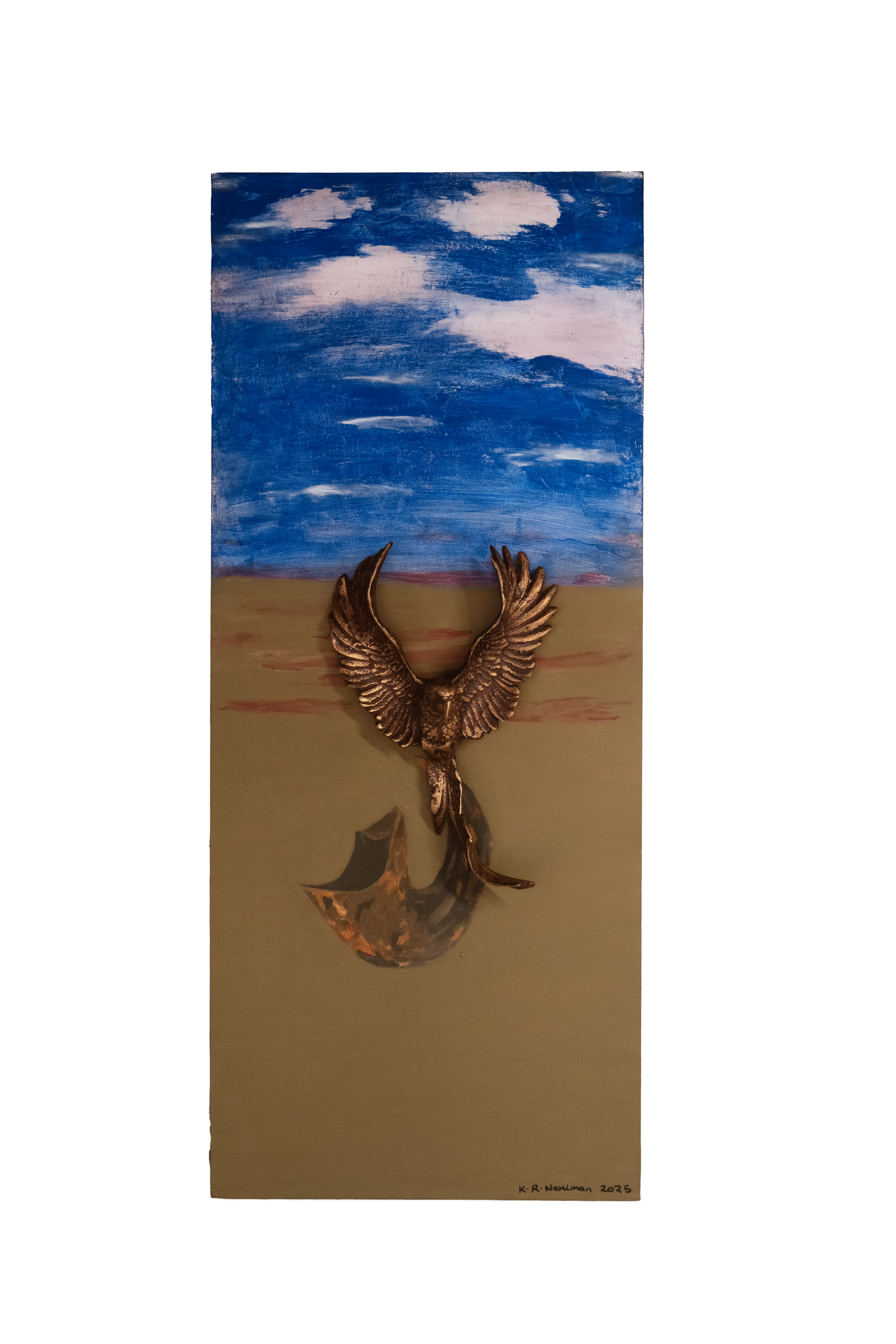 Squawk.Image Courtesy: K. R. Nariman.
Each section of the exhibition takes inspiration from an element of nature, depicting beauty and turbulence in equal measure. Air is a metaphor for man’s ambition and his insatiable need to conquer vast heights. Land depicts the need to feel rooted in one’s identity. With water, she muses on movements and memory, while fire fuels man’s endeavours. Alongside these are earlier works depicting human relationships in a variety of forms.
Delicately sculpted fish, both large and small, are the central motif of the section dedicated to water. In the series ‘Marina’ and ‘School’, they appear to swim elegantly through patina-ed waves, rotating gently with an electrical connection or with the effect of the projected film. It shows the unique dichotomy of water – its ability to exhibit a stillness which emerges from ceaseless motion. Water as the cradle of life finds meaning in her polished bronze sculpture ‘Froth’, reminiscent of atoms and molecules dancing together in strands of DNA. Nariman’s tiny turtles flanking this piece, pay tribute to her grandmother with a nod to the animal’s wisdom, longevity and positivity.

Wings of thought. Image Courtesy: K. R. Nariman.
To depict the element of air, Nariman plays with scale and form. In a striking work called ‘Stilt’, a woman is lifted upwards by a murmuration of starlings to ascend to heights perhaps hitherto denied her. In ‘His Majesty’, her male counterpart is showed as an imposing eagle, which sits upon a large talon, beset with tiny humans. There is no mistaking the grandiosity of this creature as it straddles life and death in its tiny claws.
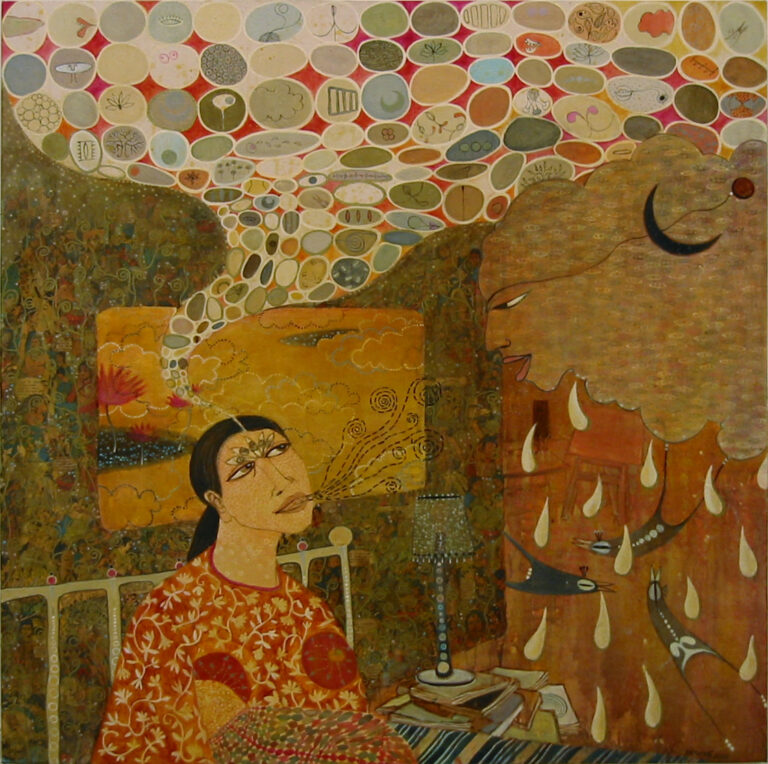
Nariman infuses intimacy and delicacy in her canvases. Hues of twilight blues and sunset embers are foregrounded by moonlike faces and delicate birds fanning their wings. In these works, and through the tiny humans she places on most surfaces, she highlights the inextricable interdependence of man and nature. ‘Alchemy’ is a good example of this, with the human fused with the gorse flower, pulling on threads of hope for a better world in which man and nature live seamlessly intertwined.
Despite the sombre and serious nature of Nariman’s chosen theme, she finds ways to infuse playfulness into her work. This is evident in the equine forms displayed preening themselves in a section inspired by Ted Hughes’ poem ‘The Horses’, and the rooster full of its own pomposity in ‘Narcissist Too’.
Grounding it all are her gentle giants – antelopes and rhinos – which stand poised with quiet pride. They are rooted to the land in a way that humans can only aspire toward. In Nariman’s words, “It is an exploration of the centrality of our bond to the elements. How we, children of life, relate to each other in our thoughts, hopes and dreams. Deeply connected to each other in ways that are hard to define, we are all a family of earth, water and air, of breath, life, and light. And what connects us is so much more important than what separates us.”
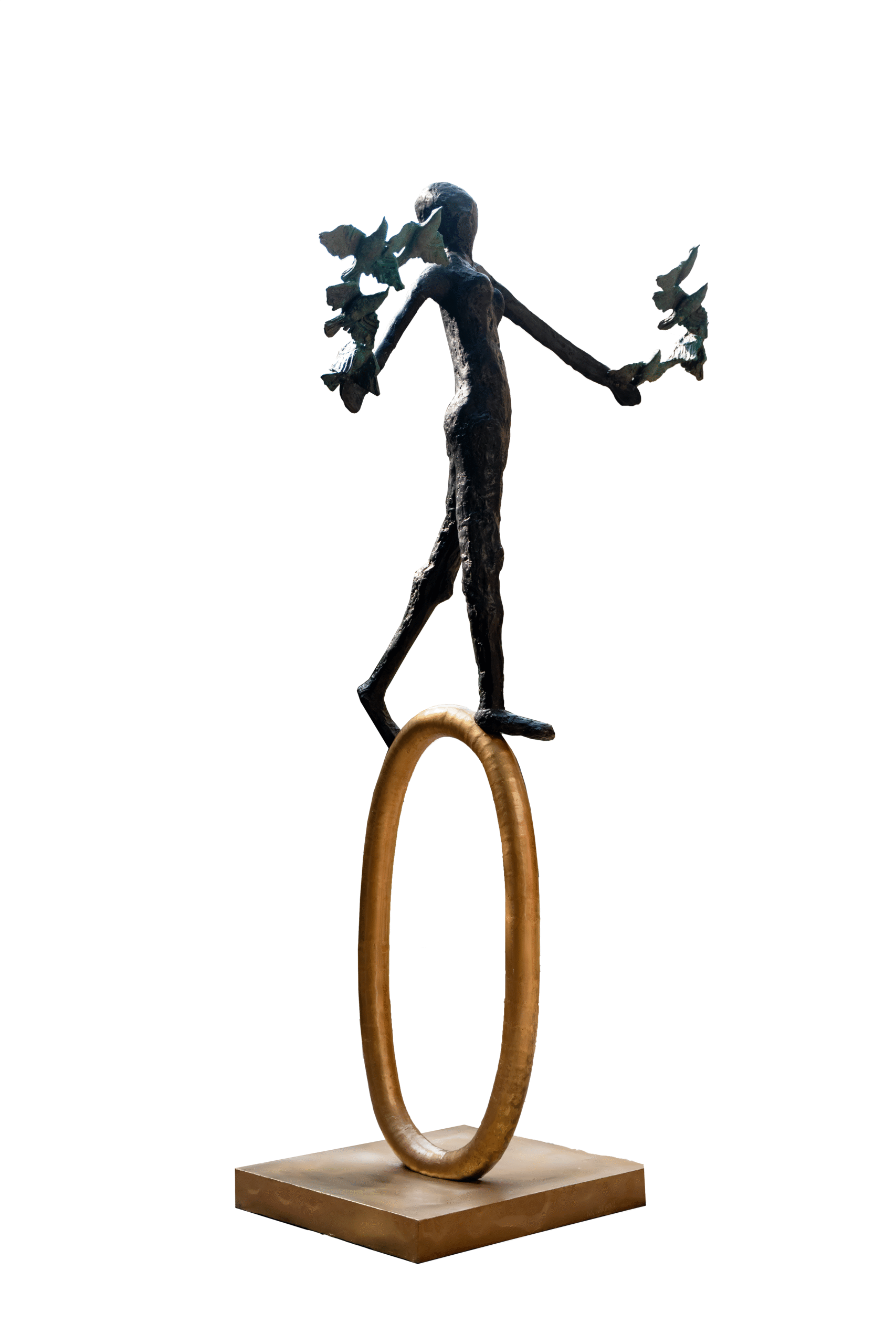
Stilt. Image Courtesy: K. R. Nariman.
Nariman’s work is impactful, and has one believe in the hope for a better future where the earth isn’t being parsed of its wildlife and where majestic creatures thrive in vast swathes of land with dignity. She calls it a display of the rational truth to our connectedness as living beings, “We would find it hard to survive without the complex ecological network of which we are a part. The wellbeing of human society is inextricably connected to how we behave with other life on this planet. The elemental pull of the earth or sea, our fascination with space, the meaning that land holds for us, our dreams of flying, the deep sense of personal connection we can feel with an animal or with a tree.”
Elemental is on display at Bikaner House Delhi till December 6, 2025.